

Resident Game Bird Seasons
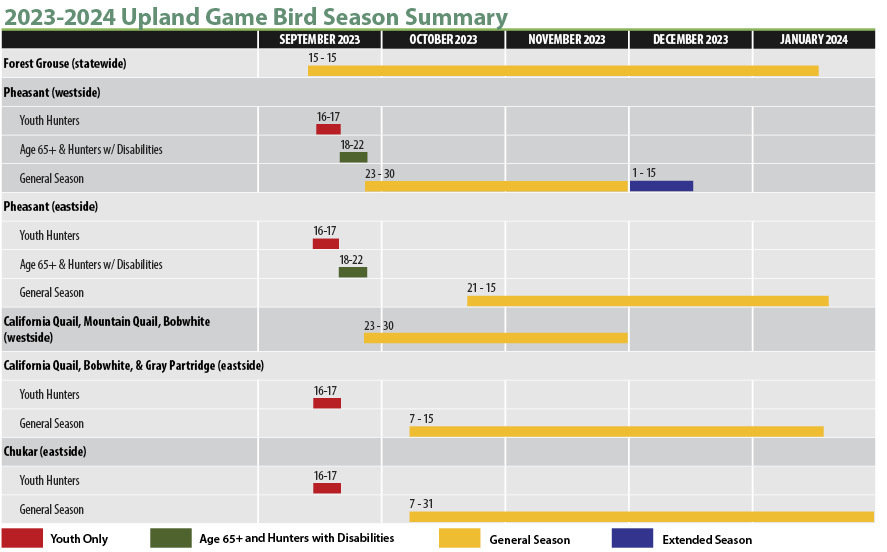
2023-2024 Upland Game Bird Seasons |
||||
Species |
Area |
Season Dates |
Daily Bag Limit |
Possession Limit |
Forest Grouse |
Statewide |
Sept. 15 - Jan. 15 |
4 grouse per day, to include not more than 3 Dusky or Sooty Grouse (combined), 3 Spruce Grouse, and 3 Ruffed Grouse. |
12 grouse, to include not more than 9 Dusky or Sooty Grouse (combined), 9 Spruce Grouse, and 9 Ruffed Grouse. |
Sage and Sharp-tailed Grouse, Ptarmigan |
Closed Statewide |
|||
Pheasant *At the Samish release site pheasants will only be released during the youth and senior seasons. Please see the WDFW website (https://wdfw.wa.gov/hunting/locations/upland-bird) for alternative sites. |
Western Washington |
8am to 4pm Sept. 16-17 (Youth Only) |
2 either sex |
4 either sex |
8am to 4pm Sept. 18-22 (Hunters 65 Years or Older, Hunters with Disabilities) |
2 either sex |
10 either sex |
||
Western Washington |
8am to 4pm |
2 either sex |
15 either sex |
|
Western Washington |
8am to 4pm Dec. 1-15 ONLY at Belfair, JBLM, Kosmos, Lincoln Creek, Scatter Creek, Skookumchuck, Green Diamond resource lands & Whidbey Island release sites |
2 either sex |
15 either sex |
|
Eastern Washington |
Sept. 16-17 (Youth Only) |
3 cocks only |
6 cocks only |
|
Sept. 18-22 (Hunters 65 Years or Older, Hunters with Disabilities) |
3 cocks only |
15 cocks only |
||
Eastern Washington |
Oct. 21 - Jan. 15 |
3 cocks only |
15 cocks only |
|
California (Valley) Quail and Northern Bobwhite |
Western Washington |
8am to 4pm Sept. 23 - Nov. 30 |
10 mixed bag |
30 mixed bag |
Eastern Washington |
Sept. 16-17 (Youth Only) |
10 mixed bag |
20 mixed bag |
|
Eastern Washington |
Oct. 7 - Jan. 15 |
10 mixed bag |
30 mixed bag |
|
Quail (Mountain) |
Western Washington |
8am to 4pm Sept. 23 - Nov. 30 |
2 either sex |
4 either sex |
Eastern Washington |
Closed throughout Eastern Washington |
|||
Gray Partridge |
Eastern Washington |
Sept. 16-17 (Youth Only) |
6 either sex |
12 either sex |
Oct. 7 - Jan. 15 |
6 either sex |
18 either sex |
||
Chukar |
Eastern Washington |
Sept. 16-17 (Youth Only) |
6 either sex |
12 either sex |
Oct. 7 - Jan. 31 |
6 either sex |
18 either sex |
||
Crow |
Statewide |
Sept. 1 - Dec. 31 |
No limit |
No limit |

