

Washington

Game Bird Hunting

Game Bird Hunting

Other Migratory Game Bird Species Identification

Identification of Snipe, Raven and Mourning Dove

Wilson’s Snipe
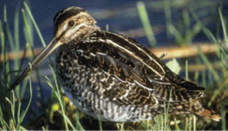
Wilson’s Snipe standing in tall grass near water, showing its long straight bill, brown mottled plumage, and striped head pattern.
A Wilson’s Snipe near the water’s edge. This migratory game bird is known for its camouflaged plumage, long straight bill, and erratic flight, making it a challenging species for hunters and birdwatchers to spot.
  • Cryptic and secretive
  • Found in marshy & flooded pasture habitats
  • Typically flush in singles or pairs
  • Two golden stripes down back
  • Single note, raspy “scaipe” call when flushed

Eurasian Collared Doves

Eurasian collared doves have recently spread across Washington. Eurasian collared doves are much larger than mourning doves (see photo), and can be taken year-round with a Washington hunting license. Mourning doves can only be taken during September through October seasons.
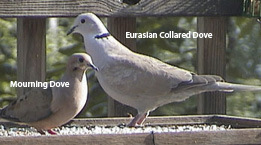
Mourning Dove and Eurasian Collared Dove perched side by side on a wooden platform feeder, showing size and color differences between the two species.
A Mourning Dove (left) and an Eurasian Collared Dove (right) at a feeder. The Mourning Dove is smaller with a slender build, while the Eurasian Collared Dove is larger with a distinct black neck ring, helping birdwatchers and hunters easily identify the two species.

Dowitchers (2 species) Not open to harvest!

Long-billed Dowitcher shown standing in shallow water and in flight, highlighting its long bill, mottled plumage, and migratory shorebird features.
Long-billed Dowitcher pictured wading in water and in flight. This migratory shorebird is recognized by its long bill and patterned plumage, key traits for birdwatchers and hunters to identify the species.
  • Tend to be more visible
  • Typically in open shallow-water & shorelines
  • Typically fly-in in small flocks
  • Obvious white stripe down back in flight

Ravens are protected by state and federal laws, and are often confused with crows. Not open to harvest!
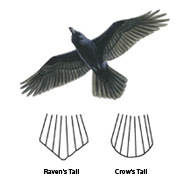
Illustration of a raven in flight with wings spread wide, accompanied by diagrams comparing the wedge-shaped tail of a raven and the fan-shaped tail of a crow.
Raven in flight with tail comparison diagram. The raven’s wedge-shaped tail differs from the crow’s fan-shaped tail, an important identification tip for birdwatchers and hunters.

Crows are smaller than ravens and measure between 17 and 20 inches long, while ravens measure between 24 and 27 inches long.

Ravens spend much time gliding when in flight, while crows seldom if ever glide and usually fly with a steady wing beat.

Crows tails are blocky and more squared off while in flight, while ravens have a diamond-shaped tail (see drawing).

Crows have a higher pitched, more nasal call, while a raven’s call is lower and hoarser.