Washington

Game Bird Hunting

Game Bird Hunting

Goose & Swan Identification

Swans are Protected by Federal and State Laws and are Closed to Harvest

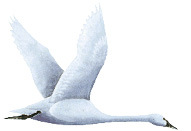
Swan, Tundra or Trumpeter
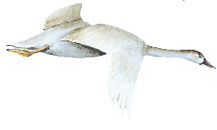
(White adult, gray juvenile, Protected Species)

Illustration of two Trumpeter Swans in flight, one viewed from the side with outstretched wings and the other from below, showing their large white bodies, long necks, and black bills.
Trumpeter Swans in flight — these large waterfowl are recognized by their white plumage, long necks, and distinctive black bills, common in wetlands and migration flyways.

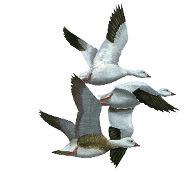
Snow Geese are:

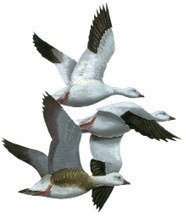
Smaller, with Shorter necks, and Black-tipped wings

Illustration of three Snow Geese in flight, showing white plumage, black wing tips, and one bird with a darker “blue morph” coloration.
Snow Geese in flight — easily identified by their white bodies with black wing tips, sometimes appearing in a darker blue morph. These migratory waterfowl are commonly seen in large flocks across North America.

Drawings courtesy of Ducks Unlimited

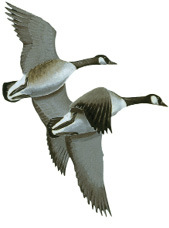
Canada Goose

Includes:
Canada (large)
Cackling (small)

Illustration of two Canada Geese in flight, showing long necks, black heads, and distinctive white cheek patches.
Canada Geese flying with their long black necks and bold white cheek patches. These large waterfowl are widely recognized across North America and migrate in familiar V-shaped flocks.

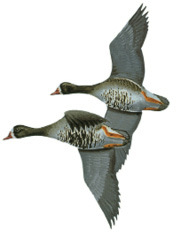
White-fronted Goose

Illustration of two Greater White-fronted Geese in flight, showing brown bodies, white facial markings at the bill, and orange legs.
Greater White-fronted Geese in flight with white facial patches, barred brown breasts, and bright orange legs. These medium-sized geese are common migratory waterfowl across North America.

White Goose

Includes:
Snow
Ross's blue phases

Illustration of a flock of white geese, also known as white-phase snow geese, in flight with black-tipped wings and red legs.
White geese, or white-phase snow geese, in flight showing their distinctive white bodies, black wing tips, and red legs. These migratory waterfowl are a key species for birdwatching and hunting identification.

Comparison of Canada Geese

Washington has seven different subspecies of Canada Geese that winter in the state, primarily in the SW Washington. Coloration of Canada and Cackling Geese can vary between subspecies and individuals. For detailed identification guidelines, hunters must complete the required online goose identification test before hunting in Goose Management Area 2.

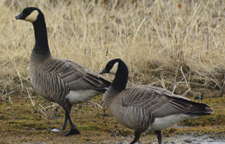
Canada Geese (Western Canada Goose pictured)
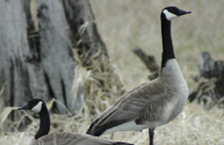
  • Large-bodied
  • Long neck, most noticeable in flight
  • Pronounced bill
    Two Canada geese standing in dry grass near a tree, showing their distinctive black necks, white chinstraps, and brown bodies.
    Canada geese in their natural habitat. These large waterfowl are easily identified by their black necks, white chinstraps, and brown plumage, common across North America in wetlands, fields, and parks.

Cackling Geese (Cackler pictured)

  • Small-bodied
  • Short neck, most noticeable in flight
  • Stubby bill
  • Typically in large flocks
    Two cackling geese walking in dry grass, showing their short necks, small bodies, and dark brown feathers with black heads and white cheek patches.
    Cackling geese in a grassy field. Smaller than Canada geese, these waterfowl are recognized by their compact bodies, short necks, and distinct black-and-white head markings. Photo courtesy of K. Plourde.