
Highly Migratory Species
Federal Highly Migratory Species Permits
To recreationally fish in federal waters for any authorized Atlantic tunas, billfishes, swordfish, and sharks (except spiny dogfish), and within the state waters for tunas, vessel owners must have a valid federal fishing permit for their vessel. A shark endorsement is needed to fish for sharks recreationally in federal waters. Call 888-872-8862 or go to hmspermits.noaa.gov/ to obtain a permit/shark endorsement.
Passengers fishing on a vessel who do not possess a highly migratory species permit or have a state saltwater fishing license must register with National Oceanic and Atmospheric Administration’s National Saltwater Angler registry. To register, go to st.nmfs.noaa.gov/nnri/.
Landing Requirements
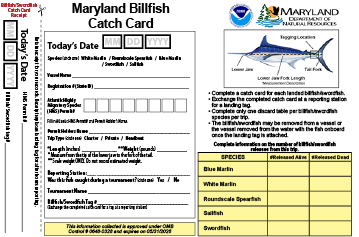
All landings of bluefin tuna, billfishes, swordfish, and sharks must be reported using the Maryland Catch Card Census. Anglers must complete a catch card and exchange it for a tag to be placed around the tail before moving it from the vessel. Sharks caught from shore must be tagged before moving from the point of landing. Boats cannot be pulled from the water until the tag is in place.
Catch cards and tags are available at the following reporting stations:
- Alltackle, Ocean City (shark tags only)
- Assateague Island National Seashore Visitor Contact Station/Campground Office Hunter’s Station, Berlin (shark tags only)
- Atlantic Tackle, Ocean City
- Bahia Marina, Ocean City
- Buck’s, Berlin (shark tags only)
- Department of Natural Resources/Natural Resources Police, Col. Jack Taylor Boathouse, Ocean City (after hours kiosk)
- Fisherman’s Marina, Ocean City
- Ocean City Fishing Center, Ocean City
- Ocean Pines Marina, Ocean Pines
- Pines Point Provisions and Seafood, Ocean Pines
- Sunset Marina, Ocean City
- Talbot Street Pier and Marina, Ocean City
- Catch cards can also be downloaded at dnr.maryland.gov/fisheries/pages/coastal/tagging.aspx
It is Illegal
- To sell, barter, or trade sharks or shark parts.
- To engage in shark finning.
- To fillet sharks at sea. All sharks caught by an angler must have heads, tails, and fins attached naturally to the carcass through landing.
- Additional information and restrictions can be found here: https://www.fisheries.noaa.gov/atlantic-highly-migratory-species/atlantic-highly-migratory-species-fishery-compliance-guides
Gear Restrictions
Anglers may use only handlines or rod and reel and must use corrodible, non-stainless circle hooks except when fishing with artificial flies/lures. You must have a device with you that is capable of quickly cutting either the leader or the hook.
Private Recreational Tilefish Permitting and Reporting
All private recreational vessels targeting or retaining golden or blueline tilefish from Virginia to Maine are subject to certain permitting and reporting requirements.
Permitting
Any recreational vessel that intends to fish for blueline or golden tilefish north of the North Carolina/Virginia border must have a Federal private recreational tilefish vessel permit before taking a trip. Apply for a permit on the Greater Atlantic Regional Fisheries Office Fish Online website, https://apps-garfo.fisheries.noaa.gov/fishtank/login/
Reporting
Recreational vessel operators must report all trips that either targeted or retained tilefish within 24 hours of returning to port using an approved electronic vessel trip reporting (eVTR) system. Learn more about eVTR options here https://www.mafmc.org/rec-tilefish-evtr.
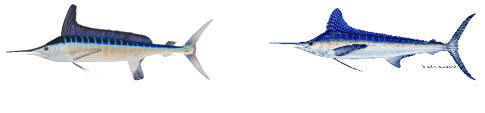
Roundscale Spearfish look very similar to white marlin
For more information on identification of swordfish and billfish, please go to: fisheries.noaa.gov/resource/educational-materials/atlantic-swordfish-and-billfish-identification-guide
HMS Catch Cards
All landings of bluefin tuna, billfishes, swordfish, and sharks must be reported using the Maryland Catch Card Census. Anglers must complete a catch card and exchange it for a tag to be placed around the tail before moving it from the vessel. Sharks caught from shore must be tagged before moving from the point of landing. Boats cannot be pulled from the water until the tag is in place. You can find catch cards at the locations listed below or you can print your own at https://dnr.maryland.gov/fisheries/pages/coastal/tagging.aspx