Maryland

Fishing

Fishing

Marine Mammals & Sea Turtles

Maryland’s Marine Mammal and Sea Turtle Stranding 24-Hour Hotline: 800-628-9944

  • In Maryland call 800-628-9944 to report all live or dead stranded sea turtles or marine mammals (including manatees, dolphins, whales, porpoises, and seals), or submit a report through the online marine animal stranding report form.
  • If calling from outside Maryland, please use:
    • Live animals: 410-373-0083 (National Aquarium Animal Program)
    • Dead animals: Call or text location and description to 443-758-6607 (Department of Natural Resources Marine Mammal and Sea Turtle Program)
  • Do not touch, harass, feed or handle live or dead marine animals. Marine mammals and sea turtles are protected by federal and state laws that specify fines of up to $50,000, imprisonment, and/or vessel confiscation.
  • Record your location using latitude/longitude, and a detailed description of your location including landmarks.
  • Estimate and note the length, size, color, noticeable body parts, and any movement of the animal.
  • Take photos of the animal.

Department biologists conduct necropsy examinations when feasible to determine cause of death, and notification of fresh carcasses is important.

Sea turtles and marine mammals: manatees, seals, dolphins and whales are included in our stranding response protocols.

Large sea turtle resting on a sandy beach in front of a front loader near the shoreline, illustrating a marine turtle response or relocation effort along the Maryland coast.
A sea turtle on a Maryland beach during a response effort, highlighting conservation actions taken to protect marine turtles and manage wildlife interactions along the Atlantic shoreline. Sea turtles in Maryland include: Kemp’s Ridley, Loggerhead, Leatherback and Green.


Large deceased whale being transported on a beach using a front-end loader, with oceanfront condominiums and response personnel visible in the background, illustrating a marine mammal response effort in Maryland.
A whale carcass is moved along a Maryland beach during a coordinated response effort, highlighting marine mammal management and public safety actions taken along the state’s Atlantic coastline. Department biologists collecting carcass of sperm whale in Ocean City, MD.


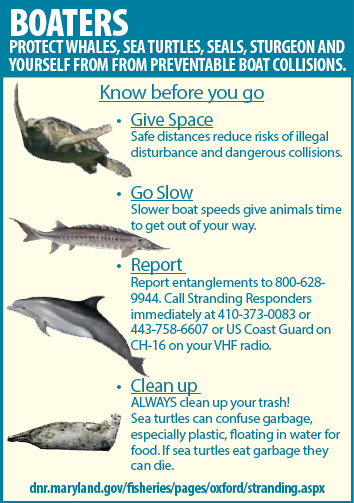
Boater safety poster urging protection of whales, sea turtles, seals, and sturgeon by giving wildlife space, slowing boat speeds, reporting entanglements, and cleaning up trash, with illustrated marine animals and contact information.
This boater safety message reminds boaters to protect whales, sea turtles, seals, and sturgeon by giving wildlife space, reducing speed, reporting entanglements, and keeping waterways free of trash to prevent dangerous and avoidable boat collisions.

Fish Passage Program

The Maryland DNR's Fish Passage Program works to support fishing by helping aquatic organisms move across barriers, like dams. The program works to improve water quality and resolve dam safety issues. We are currently partnering with American Rivers to obtain a feasibility study to determine the future of Daniel's Dam on the Patapsco River. Other recent projects include an eel ladder at Eden Mill and a dam removal in Cypress Branch State Park. For more information on the Fish Passage Program, please visit the Maryland Department of Natural Resources Fish Passage Program page.

Small stream flowing through a winter landscape with snow and ice, showing culvert pipes and rock stabilization along the bank, illustrating stream restoration or water flow management in cold conditions.
A winter view of a Maryland stream showing flowing water, ice cover, and culvert infrastructure, highlighting waterway management and habitat conditions during colder months.

The Cypress Branch Dam Removal Project was completed in April of 2025 reopening over 35 miles for herring, hickory shad, and more.