

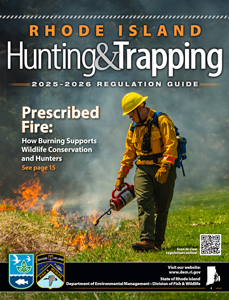
Prescribed (Rx) Fire
By Ben Arnold, Prescribed Fire Burn Boss Type 2 (RXB2)

Prescribed fire operation targeting grassland habitat, March 2025. Photo by DEM Fire Program.
In recent years, RI DEM has begun to increase its use of prescribed fire (Rx fire) as a land management tool on state-owned lands. The use of Rx fire has many benefits, including hazard fuel reduction; reducing the amount of dead woody fuel available to burn in a given area, thus reducing the intensity of a wildfire were one to start. Rx fire can also reduce tick populations in a burn unit area and improves wildlife habitat for early successional species. In addition, Rx fire provides valuable training opportunities to firefighters, to better prepare them for wildfire response.
All Rx fire that occurs on RI state lands and management areas, managed by the Divisions of Forest Environment or Fish & Wildlife, includes specific habitat goals for management as one of the many objectives outlined in the respective burn plan. Aging forests, insect infestations and invasive species are some of the many issues that affect RI’s wildlands. Rx fire is a tool that can improve these habitats for both wildlife, and the hunter. Fire can maintain and create open, grassy habitats for wild turkeys, while reducing dense and woody vegetation that predators can use to ambush them. Fire can stimulate new growth of grasses, plants and forbs providing whitetail deer with nutritious forage. Rx fire promotes a wider variety of plant species which provides a more diverse habitat for upland game birds, while also encouraging the growth of shrubs and young trees which can provide cover and nesting sites. Rx fire improves habitat in fields stocked with pheasant as well as reducing invasive plants, making the fields easier to access.
Rx fire “burn plans” are written for specific areas, typically by state management areas. These burn plans are a detailed document outlining ignition strategies, staffing and equipment requirements, weather and environmental parameters, fire behavior calculations, and area maps and smoke effect mitigations, among other topics applicable to implementing a Rx fire operation. These burn plans will typically outline “sub-burn units” within a state management area. A Rx burn crew may complete one or more sub-units in each operational period depending on crew size, weather conditions and burn objectives. Advance notice is usually given by DEM via social media posts. Property owners closely adjacent to burn units will be directly notified.
Rx fire requires specific weather conditions and environmental parameters to meet burn objectives. These conditions can potentially occur anytime of year, even during hunting seasons. Precautions are taken to minimize the impact to users of state lands. Notifications are posted on social media prior to burn days. Signs are posted on roadways and trails leading to burn areas. Burn units are typically gridded, or “swept” by burn crew members to find and remove any wildlife that may be impacted by fire. These sweeps are also utilized to locate tree stands, ground blinds, trail cameras and other equipment used by hunters. Preparations can then be taken to protect this equipment. Fuel around the equipment can be removed or wet down. Ignition tactics can be altered or adjusted to minimize impact from heat and flames. If these methods don’t work, the equipment may be removed from the unit if possible.
RI’s biologists and land managers are continuously looking for opportunities to improve habitat for both wildlife and hunters alike. Rx fire is an effective way to meet these improvement goals while reducing the amount of hazard fuels in our state management areas. Improved habitat means a better environment for wildlife, safer and more diverse management areas, and a better experience for hunters.

