

Fishing Methods
Utah Code § 23A-5-309
There are laws and rules that govern fishing in Utah. By obeying these regulations and being an ethical angler, you will help keep fishing great for everyone. Please be familiar with the following general rules for taking fish and crayfish. You’ll find some exceptions to these rules in the Rules for specific waters section and Underwater spearfishing below.
Taking game fish
You may take game fish using only the following methods:
Angling
Utah Admin. Rules R657-13-6, R657-13-7 and R657-13-11
- If you are under age 12 or have a valid Utah fishing or combination license, you can fish with two poles at any water in the state during its open fishing season. You may keep only one daily limit of fish. Using a second pole does not allow you to keep two daily limits of fish. You may use additional lines or hooks when you are:
- Fishing for crayfish. Please see page 16 of this guide for more information about fishing for crayfish.
- Using a setline. See page 13 to learn more about fishing with a setline.
- Ice fishing at Flaming Gorge and (new) Porcupine and Causey reservoirs and Pelican Lake. Please see Rules for specific waters for more information about each of these waterbodies.
While fishing, you must be within sight of the equipment you’re fishing with (this distance cannot exceed 100 feet). The only exception to this rule is if you have a setline permit.
There are a few additional angling rules to keep in mind:
- No artificial lure may have more than three hooks.
- No line may have attached to it more than three baited hooks, three artificial flies or three artificial lures. (This rule also applies to those who are fishing for crayfish.) This does not apply to setlines.
- (New) The use of artificial light is allowed when angling statewide. (Important: See Underwater spearfishing below for rules regarding artificial light.)
- When you’re fishing through the ice, you may not fish through a hole that’s more than 12 inches wide. The only exceptions are at Bear Lake, Flaming Gorge Reservoir and Fish Lake. For more information about ice fishing at these waters, visit the Rules for specific waters page.
Angling is permitted from motorized and nonmotorized watercraft on any water where such use is authorized. There are some waters, however, where you cannot fish from a float tube or a boat.
Keep in mind that other agencies may have placed additional restrictions on the use motorized and nonmotorized watercraft at certain Utah waters.
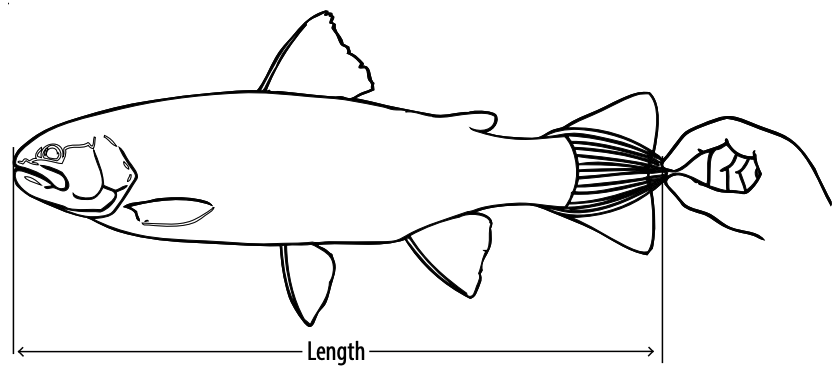
How to measure a fish
1. Place the fish on its side with the jaw closed.
2. Squeeze the tail (caudal) fin together or turn it so you obtain the maximum overall length.
3. Measure a straight line from the tip of the snout to the extreme tip of the tail fin.
Bait
Utah Admin. Rule R657-13-12
You may legally use or possess corn while fishing anywhere in Utah where bait is permitted.
You may only use live crayfish for bait if you are on the water where the crayfish were captured. It is unlawful to transport live crayfish away from the water where they were captured.
You may use bait—without hooks—to catch crayfish in waters where fishing with bait is prohibited. You may not, however, catch fish using bait in waters where bait is prohibited.
While you are fishing, it is unlawful to:
- Use or possess live baitfish.
- Use or possess tiger salamanders (live or dead).
- Use or possess any bait—including PowerBait or scented jigs—where prohibited.
- Use or possess artificial baits that are commercially imbedded or covered with fish or fish parts.
- You may not use or possess bait in the form of fresh or frozen fish or fish parts, except as provided below:
- Dead Bonneville cisco may be used as bait only in Bear Lake.
- Dead yellow perch may be used as bait only in Big Sand Wash, Deer Creek, Echo, Fish Lake, Gunnison, Hyrum, Johnson, Jordanelle, Mantua, Mill Meadow, Newton, Pineview, Red Fleet, Rockport, Starvation, Utah Lake, Willard Bay and Yuba reservoirs.
- Dead white bass may be used as bait only in Utah Lake and the Jordan River.
- Dead burbot and (new) lake trout from Flaming Gorge may be used as bait only in Flaming Gorge.
- Dead shad from Lake Powell may be used as bait only in Lake Powell. It is illegal to remove dead shad from the Glen Canyon National Recreation Area.
- Dead striped bass from Lake Powell may be used as bait or chum only in Lake Powell.
- Dead, fresh or frozen saltwater species, including sardines and anchovies, may be used as bait in any water where bait is permitted.
- Dead mountain sucker, white sucker, Utah sucker, redside shiner, speckled dace, mottled sculpin, fathead minnow (all color variants, including rosy red minnows), Utah chub and common carp may be used as bait anywhere bait is permitted.
- The eggs of any species of fish caught in Utah, except prohibited fish, may be used where bait is permitted. You may not, however, take or use eggs from fish that are being released.
Commercially prepared and manufactured bait
Utah Admin. Rule R657-13-12
You may use commercially prepared and chemically treated baitfish or their parts as bait in any water where bait is permitted.
Manufactured, human-made items that may not be digestible—including items that have been chemically treated with food stuffs, chemical fish attractants or feeding stimulants—may not be used where bait is prohibited.
Both PowerBait and scented lures are considered to be bait, and they may not be used where bait is prohibited.
Restrictions on bait from AIS-infested waters
Utah Admin. Rule R657-13-12
If the Utah Wildlife Board has declared that a water is infested with an aquatic invasive species (e.g., quagga or zebra mussels)—or the water is subject to a closure order or control plan—you may not transport dead fish of any species, including baitfish, from that water to use in any other water. To determine whether a waterbody is infested, visit the Utah Division of Wildlife Resources invasive mussels page.
Restrictions on taking fish
Utah Admin. Rule R657-13-11
You may not obstruct a waterway or use any chemical, explosive, electricity, poison, firearm, pellet gun or archery equipment to take fish. The only exceptions are found in Taking nongame fish, Fishing with archery tackle and crossbows, and Rules for specific waters, Lake Powell.
You may not take or land a fish by snagging or gaffing, and you may not have a gaff in your possession while fishing. A fish hooked anywhere other than the mouth must be released immediately. The only exceptions are at Lake Powell (where you may use a gaff to land striped bass), Bear Lake (where you may snag Bonneville cisco) and any waterbody where there is a catch-and-kill regulation for the fish you snag.
Chumming is prohibited on all waters except Lake Powell and (new) Flaming Gorge. Please see the Rules for specific waters for more information about each of these waters.
How to report new fishing records
You can view current fishing records and download submission forms on the Utah Division of Wildlife Resources website.
Important: Your application photo(s) must clearly show the length of your catch against a measuring device.
The list of Utah fishing records is extensive and changes multiple times each year. To ensure accuracy, that list is now available online only.
Setline fishing
Utah Admin. Rule R657-13-8
Setlines are lines that are anchored to a non-moving object and that are not attached to a fishing pole.
Setline permits are available at wildlife.utah.gov and from license agents and Division offices (a 365-day permit is $22 for residents and $25 for nonresidents).
If you are 12 or older, you must also have an unexpired three-day, seven-day, 365-day or multi-year Utah fishing or combination license in order to use a setline permit.
If you obtain a setline permit, and a Utah fishing or combination license, you can use a setline to take fish from the following waters: Bear River proper (downstream from the Idaho state line, including Cutler Reservoir and outlet canals); Little Bear River below Valley View Highway (SR-30); Malad River; Utah Lake; and (new) Yuba Reservoir. These are the only waters where use of a setline is allowed.
The following rules apply to setline fishing:
- You may not fish with more than one setline.
- A setline may not contain more than 8 hooks (new maximum number).
- (New) Setlines may not be mechanically retrieved.
- (New) Setlines must be tended at least once every 48 hours.
- Only anglers possessing a setline permit may tend their setline.
- One end of your setline must be attached to a non-moving object that is not attached to a fishing pole.
- Your setline must be permanently marked with the angler’s setline permit number.
- While fishing with a setline, you can also fish with up to two fishing poles.
Dipnetting
Utah Admin. Rule R657-13-10
You can use a handheld dipnet to land game fish that you’ve legally taken by angling. However, you may not use a handheld dipnet as a primary method of taking game fish unless you are at Bear Lake, where you may use a dipnet to take Bonneville cisco.
When fishing for Bonneville cisco at Bear Lake, the opening of your dipnet may not exceed 18 inches. If you’re dipnetting through the ice at Bear Lake, there is no restriction on the size of the hole you can drill in the ice. Please see Rules for specific waters, Bear Lake for more information.
You may also use a handheld dipnet to take crayfish and nongame fish, except prohibited fish. For a list of fish you are prohibited to possess, please see the Prohibited Fish section below.
Fishing with archery tackle and crossbows
Utah Admin. Rule R657-13-14
Fishing with archery tackle—also called bowfishing—is allowed in most Utah waterbodies but only for nonprotected, nongame fish such as carp. And within that limitation, there are waters where you may bowfish for carp only.
In most areas, bowfishing is allowed at night with the use of spotlights. There are a few notable exceptions: The tributaries of Utah Lake are closed to bowfishing at night (sunset to sunrise) from May 7 until 6 a.m. on July 9. A few other lakes, including Lake Powell, have closed areas. If you’re wondering about a specific waterbody, see the Rules for specific waters section that or call the Division office that manages that particular fishery.
Using a crossbow or airgun
You may use a crossbow or (new) airgun that fires arrows or bolts (archery tackle) to take carp at any open water statewide. You may not use a crossbow or airgun to take any other species of fish. Important: See Definitions for a description of allowable equipment.
Follow local ordinances
Please remember that archery tackle and crossbows are considered weapons and cannot be discharged within 600 feet of a structure. Also, local communities or land management agencies may have ordinances against the discharge of weapons within city limits or managed areas. If possible, please check with the applicable management authority to make sure you are following all the rules.
If you have additional questions about bowfishing or the places you can bowfish, please contact your local Division office.
Watercraft restrictions
Before you launch a boat at any waterbody, be sure to check with local, state or federal agencies about any watercraft restrictions that may exist.
Regulations differ from one water to another, depending on which municipality or agency is in charge. It’s your responsibility to learn and follow the rules for a particular water.
You can learn more about boating in Utah and view watercraft restrictions on the Utah Division of Recreation website.
Closed areas
Utah Admin. Rule R657-13-19
All of the state’s fish hatcheries are closed to fishing, including the warmwater fish hatchery at the Lee Kay Public Shooting Range.
All of the state’s waterfowl management areas are closed to fishing, unless they’re posted open to fishing or they’re listed as open to fishing in Rules for specific waters.
All national wildlife refuges within Utah are also closed to fishing, unless declared open by the managing authority.
Trespassing
Utah Code §§ 23A-5-317 and 23A-5-310
While fishing or engaging in wildlife-related activities, you may not—without permission— enter or remain on privately owned land that is:
- Cultivated
- Properly posted
- Fenced or enclosed in a manner designed to exclude intruders
- In addition, you may not:
- Enter or remain on private land when directed not to do so by the owner or a person acting for the owner.
- Obstruct any entrance or exit to private property.
“Cultivated land” is land that is readily identifiable as land whose soil is loosened or broken up for the raising of crops, land used for the raising of crops, or a pasture that is artificially irrigated.
“Permission” means documented authorization from the owner or person in charge to enter upon private land that is cultivated or properly posted. Permission must include all of the following details:
- The signature of the owner or person in charge
- The name of the person being given permission
- The appropriate dates
- A general description of the land
“Properly posted” means that signs prohibiting trespass—or bright yellow, bright orange or fluorescent paint—are clearly displayed at all corners, on fishing streams crossing property lines, and on roads, gates and rights-of-way entering the land. Or, they are displayed in a manner that is visible to a person in the area.
You may not post private property you do not own or legally control or land that is open to the public as provided by Utah Code § 23A-6-402. In addition, it is unlawful to take protected wildlife or its parts while trespassing in violation of Utah Code § 23A-5-317.
You are guilty of a class B misdemeanor if you violate any provision described in this section. Your license, tag or permit privileges may also be suspended.
Native American Trust Lands
If you’re fishing on land that belongs to any of the Native American tribes in Utah, you must observe tribal regulations. These regulations are available from the Native American tribe that owns the land.
Taking crayfish
Utah Admin. Rule R657-13-15
If you’re under the age of 12, you do not need a license to fish for crayfish. If you’re 12 years of age or older, you must have a valid Utah fishing or combination license to fish for crayfish.
You may take crayfish for personal, noncommercial purposes at any body of water where there’s an open fishing season. You may not take crayfish if the fishing season at that water is closed.
You may take crayfish by hand or with a trap, dipnet, liftnet, handline, pole or seine. New clarification: You may not obstruct a waterway or use any chemical, explosive, electricity, poison, firearm, pellet gun or archery equipment to take crayfish.
- You must also obey all of the following rules:
- You may not use game fish or their parts for bait, or use any substance that is illegal for fishing.
- Seines (nets) may not exceed 10 feet in length or width.
- You may not use more than five lines, and only two of those lines can have hooks attached. On the lines without hooks, simply tie your bait to the line so the crayfish can grasp the bait with its claw.
Reminder: You may use bait—without hooks—to catch crayfish in waters where fishing with bait is prohibited. (You may not, however, catch fish using bait in waters where bait is prohibited.)
You may not transport live crayfish away from the body of water where you captured them.
For additional information about catching and preparing crayfish, visit the Utah Division of Wildlife Resources crayfish page.
Prohibited fish
Utah Admin. Rule R657-13-13
The following is a list of threatened or endangered native species. If you catch any of these fish, you must release them (alive) immediately:
- Bonytail
- Colorado pikeminnow
- Humpback chub
- June sucker
- Razorback sucker
- Virgin River chub
- Woundfin
The following is a list of non-native nuisance fish species. If you catch any of these fish, please do not release them back into the water. Please keep the fish (dead) and report your catch to a local DWR official:
- Alewife
- Asian swamp eel
- Bighead carp
- Black carp
- Bowfin
- Brook stickleback
- Convict cichlid
- Eurasian ruffe
- Flathead catfish
- Gar
- Grass carp
- Ide
- Piranhas
- Nile perch
- Northern snakehead
- Red bellied pacu
- Red shiner
- Round goby
- Rudd
- Sand shiner
- Sea lamprey
- Silver carp
- South American parasitic catfish
- Tiger fish
- Tench
- Tilapia
- Walking catfish
Stream access in Utah
In recent years, Utah’s stream access laws have changed multiple times as a result of legislation, litigation and judicial rulings. That may continue to be the case in the years to come.
The Division is committed to upholding the laws—however they change—and wants to help anglers understand them.
For more information and answers to common questions about stream access in Utah, visit the Utah Division of Wildlife Resources stream access page.Taking nongame fish
Utah Admin. Rule R657-13-14 and R657-12-8
If you have a valid Utah fishing or combination license, you may take nongame fish — except those listed in the Prohibited fish section — for personal, noncommercial purposes, as long as you’re fishing at a body of water during its open fishing season.
To take nonprohibited nongame fish, you may use angling, traps, archery, dipnets, cast nets, liftnets, seines or a handheld spear from above the surface of the water.
When using these methods, please remember the following rules:
- Seines (nets) may not exceed 10 feet in length or width.
- Cast nets may not exceed 10 feet in diameter (a 5-foot radius).
- Nongame fish that are legal to take must either be released or killed immediately after you remove them from the water. You may not leave them on the shoreline.
Underwater spearfishing for nongame fish—other than carp and (new) Utah chub—is only allowed at the waters listed.
You may use a crossbow or (new) airgun only if you’re taking carp.
Taking common carp
You may use a variety of techniques—including angling, traps, archery, dipnets, cast nets, liftnets, seines, crossbow, (new) airgun using archery tackle, a handheld spear from above the surface of the water, or underwater spearfishing—to take common carp in any water during its open fishing season.
For more information on bowfishing rules, see Fishing With Archery Tackle and Crossbows section.
You may use artificial light while bowfishing or spearfishing for carp.
Carp are the only nongame fish you may take in the following waters:
- Ash Creek
- Beaver Dam Wash
- Colorado River
- Diamond Fork
- Duchesne River (from the Myton SR-40 bridge to the confluence with the Green River)
- Fort Pierce Wash
- Green River (from the Colorado state line in Browns Park upstream to Flaming Gorge Dam, including Gorge Creek, a tributary that enters the Green River at Little Hole)
- Green River (from the confluence with the Colorado River upstream to the Colorado state line in Dinosaur National Monument)
- Hobble Creek
- La Verkin Creek
- Main Canyon Creek (tributary to Wallsburg Creek)
- Provo River (below Deer Creek Dam)
- Raft River (from the Idaho state line, including all tributaries)
- San Juan River
- Santa Clara River (from Pine Valley Reservoir downstream to the confluence with the Virgin River)
- Snake Valley waters (west and north of US-6 and the part of US-6 and US-50 in Millard and Juab counties)
- Spanish Fork River
- Thistle Creek
- Virgin River (main stem and the north and east forks)
- Weber River
- White River (Uintah County)
- Yellow Creek
Fish Utah interactive map
The Fish Utah website offers an in-depth, interactive map that will help you find a place to fish near you, review stocking reports, get fishing tips by waterbody, see our biologists’ fishing forecasts and more! Get ready for your next fishing adventure by visiting the Utah fishing information website.
Taking brine shrimp
Utah Admin. Rule R657-52
Many people who visit the Great Salt Lake want to take some of the lake’s brine shrimp home with them. You may take brine shrimp from the lake without a fishing license, but you may not take more than one gallon in a 7-day period.
Roundtail: a unique sportfish opportunity
Roundtail—also known as roundtail chub—are a fish species native to the Colorado River drainage. In Utah, they are found in the Green and Colorado rivers and several tributaries.
Until recently, the DWR did not promote fishing for roundtail because population declines had resulted in the species receiving a protected status in Utah and other Western states. However, some areas of Utah maintain healthy populations of roundtail that can provide angling opportunities without impacting their numbers.
Roundtail may be targeted as a sportfish in Utah, and are most likely found in portions of the following waters: Escalante River, McElmo Creek, Colorado River, Dolores River, Green River, San Rafael River and White River. The statewide limit for roundtail chub is 2 fish unless otherwise specified in the Rules for specific waters.
The roundtail’s native Colorado River drainage flows through some of Utah’s most beautiful and remote areas, giving anglers an appreciation both for this seldom-seen fish and the remarkable habitat it occupies.
Underwater Spearfishing
Utah Admin. Rule R657-13-9
The challenging sport of underwater spearfishing has become very popular in Utah. When spearfishing, you are subject to all of Utah’s fishing rules, regulations, daily limits and licensing requirements.
In addition to the following information, carefully review Rules for specific waters.
Taking game fish
Utah Admin. Rule R657-13-9
See General rules: fishing methods above and Definitions for allowable equipment and methods.
New: Underwater spearfishing may take place 24 hours a day where allowed (previously, spearfishing hours were from official sunrise to official sunset).
Free shafting is prohibited.
Important: It is illegal to use artificial light while underwater spearfishing with the following two exceptions:
- If you’re underwater spearfishing for burbot or lake trout at Flaming Gorge.
- If you’re underwater spearfishing for common carp or Utah chub anywhere in the state where spearfishing is allowed.
At all waters open to fishing—during their open seasons—you can underwater spearfish for common carp and Utah chub, except for the Provo River and Provo River Delta.
Remember: All possession limits and seasonal closures apply, regardless of the fishing technique you use. (This includes the statewide seasonal closure on kokanee salmon from Sept. 10 to Nov. 30.)
Waterbodies open to spearfishing
Only the waters listed below are open to underwater spearfishing for game fish year-round. Unless otherwise noted, you may underwater spearfish to take any legal species within the daily limits, length limits and seasonal closures that apply to each waterbody.
Big Sand Wash Reservoir, Duchesne County
Brown’s Draw Reservoir, Duchesne County
Causey Reservoir, Weber County
Electric Lake, Emery County
Grantsville Reservoir, Tooele County
Porcupine Reservoir, Cache County
Uinta Mountains, Daggett, Duchesne, Summit and Uintah counties
- At the following high-elevation lakes: Alexander Lake, Chepeta Lake, China Lake, Fish Lake (Weber River drainage), Hacking Lake, Hoop Lake, Hoover Lake, Moccasin Lake, Papoose Lake, Paradise Park Lake, Sand Lake, Smith and Morehouse Reservoir, Spirit Lake, Upper Stillwater Reservoir, Wall Lake, Whitney Reservoir and Wigwam Lake.
(PR) Willard Bay Reservoir, Box Elder County
Yuba Reservoir, Juab and Sanpete counties
Seasonal bass closures
The following waters are closed to the possession of largemouth and smallmouth bass from April 1 through June 28, 2025 (the fourth Saturday in June) while underwater spearfishing. When you are spearfishing for bass at these waterbodies, all daily limits and length limits apply.
(PR) Deer Creek Reservoir, Wasatch County
East Canyon Reservoir, Morgan County
Echo Reservoir, Summit County
Flaming Gorge, Daggett County
- Additional restrictions apply. See exceptions below.
(PR) Lake Powell, Garfield, Kane and San Juan counties
- Additional restrictions apply. See exceptions below.
(PR) Pineview Reservoir, Weber County
- Additional restrictions apply. See exceptions below.
Recapture Reservoir, San Juan County
Red Fleet Reservoir, Uintah County
Rockport Reservoir, Summit County
(PR) Starvation Reservoir, Duchesne County
Steinaker Reservoir, Uintah County
Exceptions
The following waters have exceptions while underwater spearfishing.
Blue Lake, Tooele County
- Pacu and tilapia only.
Jordan River, Salt Lake and Utah counties
- Northern pike only.
Fish Lake, Sevier County
- You may underwater spearfish for all fish species from 6 a.m. on the first Saturday in June until official sunset on Sept. 9.
(PR) Flaming Gorge, Daggett County
- Underwater spearfishing for burbot and lake trout is allowed year-round, 24 hours per day.
- Artificial light is allowed while spearfishing for burbot and lake trout. Artificial light may not be used to take any other fish species with spearfishing techniques.
- The length of shooting lines used when spearfishing is restricted to 20 feet.
(PR) Lake Powell, Garfield, Kane and San Juan counties
Archery and underwater spearfishing are prohibited within all of the following areas:
- One-quarter mile of all existing developed areas, including shoreline campgrounds, docks, launch ramps, breakwaters and trailheads.
- One-quarter mile of any structure, including any building, shed, pump-out, boat dock, breakwater, permanent harbor fixture, camper, motor home, trailer, tent or vehicle
- Rainbow Bridge National Monument.
- One-quarter mile of Dangling Rope Marina, including any land- or harbor-based structures.
- One hundred yards (300 feet) of any boats (unless the person owns, rents, leases or lawfully occupies the boat), or another boat moves into the 100-yard perimeter after the bow or spearfishing activity has commenced.
Pineview Reservoir, Weber County
- CLOSED year-round to the take of tiger muskie.
Newcastle Reservoir, Iron County
- Wipers and rainbow trout only.
(PR) Quail Creek Reservoir, Washington County
- Smallmouth bass only.
Utah Lake, Utah County
- Northern pike and white bass only.
Utah Lake tributaries, Utah County
- Underwater spearfishing is allowed for white bass and northern pike in the following tributaries west of I-15: American Fork Creek, Beer Creek, Dry Creek, Hobble Creek, Spanish Fork River, Spring Creek and Spring Creek Run.
- Spearfishing is not permitted for other species in these tributaries.
- Spearfishing is not permitted in the Provo River or Provo River Delta.
