

Statewide Daily & Size Limits
Species |
Daily Limit |
Size Limit |
Largemouth and/or Smallmouth Bass (A) |
6 (combined) |
1 (one) over 16 inches |
Spotted Bass (A) |
None |
None |
Channel and/or Blue Catfish (B) |
15 (combined) |
Only 1 Blue Catfish over 30 inches |
Flathead Catfish (B) |
5 |
None |
White and/or Black Crappie |
37 (combined) |
None |
Striped Bass (C) |
5 (except Lake Texoma) |
None |
Striped Bass Hybrids (C) |
20 |
Only 5 fish over 20 inches |
White Bass |
None |
None |
Trout (C) |
See Trout regulations on Trout Regulations |
|
Walleye, Sauger and/or Saugeye |
6 (combined) |
14 inch minimum |
Paddlefish (C,D) |
See Paddlefish regulations on Paddlefish regulations |
None |
Alligator Gar (D,E) |
1 |
None |
(All species not listed, except shad (F) and species of special concern I and/or II (G), have no minimum size limits) |
||
Some areas have different regulations. See “Public Fishing Waters” special regulations for daily and size limits on specific areas. No daily or size limits exist for any fish species fished from privately owned ponds and lakes. |
||
Black Bass (Largemouth, Smallmouth & Spotted Bass)
Statewide Daily Limit:
- Largemouth & Smallmouth – 6 (combined)
- Spotted – None
Statewide Minimum Size Limit:
- Largemouth & Smallmouth – 1 (one) over 16 inches
- Spotted – None
Check "Public Fishing Waters" special regulations for areas with additional daily and size limits.
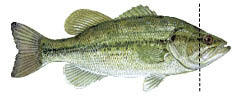
Largemouth Bass
- Mouth hinge well behind eye
- State record: 14 lbs., 13.7 oz.
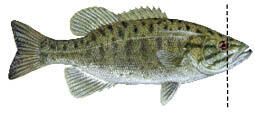
Smallmouth Bass
- Mouth hinge in front of eye
- State record: 8 lbs., 7 oz.
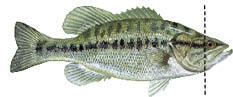
Spotted Bass
- Mouth hinge even with back edge of eye
- State record: 8 lbs., 2 oz.
Tooth Patch: Another way to distinguish black bass is the presence or absence of a tooth patch on the tongue. The majority of largemouth bass have no tooth patch on the tongue, while smallmouth and spotted bass do have a tooth patch on the tongue.

Most largemouth bass have no tooth patch on the tongue.

Smallmouth and spotted bass display a tooth patch on the tongue.
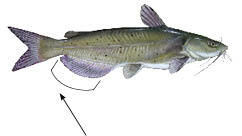
Channel Catfish
- Curved anal fin
- State record: 35 lbs., 15 oz.
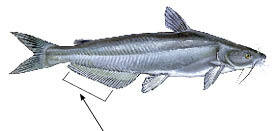
Blue Catfish
- Straight anal fin
- State record: 98 lbs.
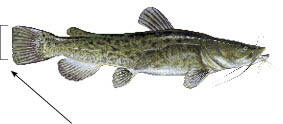
Flathead Catfish
- Tail not forked
- State record: 78 lbs., 8 oz.
Catfish
Statewide Daily Limit:
- Channel and/or Blue Catfish combined – 15
- Flathead Catfish – 5
Statewide Size Limit:
- Channel Catfish – None
- Blue Catfish – Only 1 over 30 inches
- Flathead Catfish – None
Check "Public Fishing Waters" special regulations for areas with additional daily and size limits.
Crappie
Statewide Daily Limit:
- 37 (combined White and/or Black crappie)
Statewide Minimum Size Limit:
- None
Check "Public Fishing Waters" special regulations for areas with additional daily and size limits.
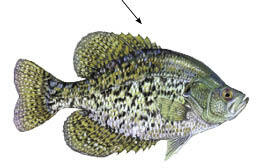
Black Crappie
- No true pattern to black spots
- 7-8 bony spines in dorsal fin
- State record: 4 lbs., 10 oz.
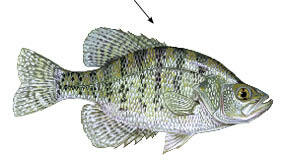
White Crappie
- Distinct vertical bands of blue/gray spots
- 5-6 bony spines in dorsal fin
- State record: 4 lbs., 15 oz.
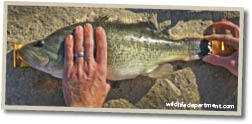
Measuring Fish
When measuring fish, total length is measured from the tip of the snout to the end of the tail, with fish laid flat on a ruler, mouth closed and tail fin lobes pressed together.
Walleye, Sauger & Saugeye
Statewide Daily Limit:
- 6 (combined)
Statewide Size Limit:
- 14 inch minimum
Check "Public Fishing Waters" special regulations for areas with additional daily and size limits.
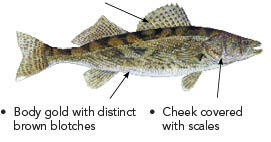
Walleye
- State Record: 12 lbs., 13 oz.
- No spots on spiny dorsal fin
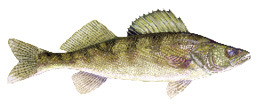
- Few or no cheek scales


Sauger
- State Record: 5 lbs., 5 oz.
- Distinct spots on spiny dorsal fin
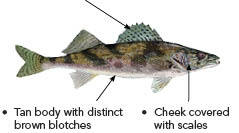
Saugeye
- State Record: 10 lbs.
- Spiny dorsal fin with distinct spots and bars in webbing
Paddlefish
Statewide Daily Limit:
- 1
Statewide Annual Limit:
- 2
Statewide Minimum Size Limit:
- None
Harvest must be reported within 24 hours via E-Check at wildlifedepartment.com.
Check Paddlefish regulations for additional paddlefish regulations.
Culling of paddlefish is prohibited.
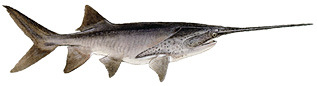
- Distinctive rounded, protruding blade in front.
- State and World Record: 164 lbs.

Alligator Gar
Statewide Daily Limit:
- 1
Statewide Minimum Size Limit:
- None
Harvest must be reported within 24 hours via E-Check at wildlifedepartment.com.
Check "Public Fishing Waters" special regulations for areas with additional daily and size limits. The attempt to take or harvest alligator gar is prohibited statewide May 1-31.
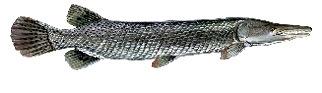
- State Record: 254 lbs., 12 oz.
Nongame Fishes
Oklahoma waters boast many catchable nongame fishes in addition to the game fishes featured here. They come in all shapes and sizes, including this massive smallmouth buffalo (a native sucker often mistaken for a carp). See https://www.wildlifedepartment.com/outdoorok/ooj/fifty-fish-factoids for more info about Oklahoma's many nongame species and their valuable roles in our aquatic communities.
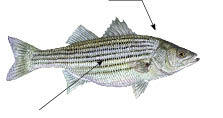
Striped Bass
- Back not arched
- State record: 47 lbs., 8 oz.
Striped Bass, White Bass & Hybrids
Statewide Daily Limit:
- Striped Bass - 5 (except Lake Texoma)
- Striped Bass Hybrids - 20
- White Bass - None
Statewide Size Limit:
- Striped Bass - None
- Striped Bass Hybrids - No more than 5 fish over 20 inches
- White Bass - None
Check "Public Fishing Waters" special regulations for areas with additional daily and size limits.
Culling of striped bass and/or striped bass hybrids is prohibited.
- Strong, unbroken dark lines
White Bass
- Arched back
- State record: 5 lbs., 1 oz.
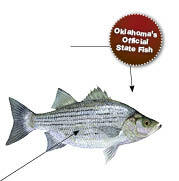
- Faint lines, usually unbroken
Striped Bass Hybrid
- Back slightly arched
- State record: 23 lbs., 3.7 oz.
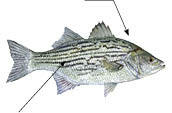
- Some broken lines
Distinguishing White Bass
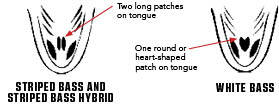
White bass are also distinguished from striped bass and striped bass hybrids by tooth patches on the tongue. White bass have a single tooth patch, striped bass and striped bass hybrids have two tooth patches.
Downward Views Inside Mouth of Lower Jaw and Tongue.
Trout (Rainbow & Brown)
Statewide Daily Limit:
- Rainbow Trout & Brown Trout - 3 Combined
Statewide Size Limit:
- None
Check Trout Regulations for areas with additional daily and size limits.
Culling of trout is prohibited.
Rainbow Trout
- State record: 11 lbs., 4.3 oz.
- Black spots on tail
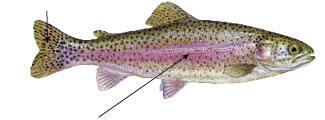
- Iridescence on sides
Brown Trout
- State record: 17 lbs., 4.6 oz.
- Few or no black spots on tail
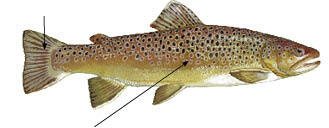
- Orange and red spots on side
