

Fishing Regulations
General Fishing Rules and Methods
Allowed fishing methods
You may take fish by pole and line, trotline, throwline, limb line, bank line and jug line. Ice fishing tackle, or tip-ups, are considered a pole-and-line method.
These methods are accepted for catching all species of fish, although additional restrictions may apply to specific fishing areas.
Game fish not hooked in the mouth or jaw must be returned to the water unharmed immediately, except paddlefish legally taken during the paddlefish snagging season. Game fish include:
- goggle-eye (commonly known as Ozark bass, rock bass, and shadow bass)
- warmouth
- northern pike
- muskellunge, tiger muskie, and muskie pike hybrid
- chain pickerel
- grass pickerel
- all species of catfish except bullheads
- all species of black bass (largemouth, smallmouth, and spotted)
- paddlefish (spoonbill)
- all species of crappie
- white bass, yellow bass, and striped bass
- trout
- walleye
- sauger
- shovelnose sturgeon.
Allowed alternate methods
You may use permitted alternate methods in designated waters to take certain species, including paddlefish (snagging/grabbing methods only) and nongame fish. Nongame fish include
- bluegill
- green sunfish
- carp
- carpsuckers
- suckers
- buffalo
- drum
- gar,
- all other species other than those defined as game fish or listed as endangered.
Permitted alternate methods for nongame fish include:
- bow
- crossbow
- gig
- atlatl
- snare
- underwater spearfishing
- snagging
- grabbing
Additional restrictions apply to specific species and fishing areas.
All of the above methods of taking fish are considered sport fishing methods.
Number of poles and hooks
If you use more than three poles (or two poles on the Mississippi River) at any one time, the additional poles must be labeled with your full name and address or Conservation Number. Regardless of the method or number of poles, you may not use more than a total of 33 hooks at any one time; except on the Mississippi River the maximum is 50 hooks at one time. If fishing on the Mississippi River and on other Missouri waters at the same time, no more than 50 hooks may be used and not more than 33 on waters other than the Mississippi.
Hooks on trotlines must be staged at least 2 feet apart. Hooks on any type of line, as well as the line itself, must be attended every 24 hours or removed.
Prohibited fishing methods
No one may use any explosive, poison, chemical or electrical equipment to kill or stupefy fish. Such material or equipment may not be possessed on waters of the state or adjacent banks.
Spearguns may not be possessed on unimpounded waters or adjacent banks, and spears may not be propelled by explosives.
It also is illegal to attempt to take fish by hand, with or without a hook, and to intentionally leave or abandon any commonly edible portion of any fish.
Only live-bait traps are allowed
Fish traps, including slat and wire ones, may not be possessed on waters in Missouri or on adjacent banks. However, live-bait traps are allowed.
Labels required on traps and lines
You must place a tag of a durable material with your full name and address or your Conservation Number on live-bait traps, trotlines, throwlines, limb lines, bank lines, jug lines and live boxes.
Use of Lights
As an aid to fishing methods, an artificial light may be used only above the water surface. However, while fishing by pole and line only, underwater lights may be used to attract fish. Underwater lights also may be used when bowfishing on lakes, ponds and other impoundments.
Conservation Area Regulations
Search Places to Go for conservation area-specific information before fishing.
Special Waterbody Regulations
Special fishing restrictions exist for particular waterbodies. Always check before you fish.
See the Special Waterbody Fishing Regulations Section
St. Louis Region Special Fishing Regulations
Statewide regulations apply for all St. Louis area lakes, except for those listed below.
Please check the posted regulation signs at the lakes before fishing.
August A. Busch Conservation Area Lakes
| Lake | Black Bass Daily Limit | Black Bass Length Limit Minimum | Catfish Combined Daily Limit | Crappie Daily Limit | Trout Daily Limit | Muskie Daily Limit | Muskie Length Limit Minimum | All Others Combined Daily Limit |
|---|---|---|---|---|---|---|---|---|
| Lakes 1, 2, 15 | Closed to public fishing. Reserved for aquatic education programs only. | |||||||
| Lake 12 | Kids fishing only; daily limit = 2 fish combined | |||||||
| Lakes 3, 22, 23 | 2 | 15 inches | 4 | 15 | 4 | N/A | N/A | 10 |
| Lakes 4, 5, 6, 7, 9, 10, 11, 19, 20, 24, 26, 27, 30, 34, 36, 37, 38 | 2 | 15 inches | 4 | 15 | N/A | N/A | N/A | 10 |
| Lakes 21, 28 | 2 | 15 inches | 4 | 15 | 4** | N/A | N/A | 10 |
| Lake 33 | 2 | 18 inches | 4 | 30 | N/A | N/A | N/A | 10 |
| Lake 35 | 2 | 18 inches | 4 | 15 | N/A | 1 | 36 inches | 10 |
| Lakes 16, 31, 32 | Catch-and-release, artificial lures only | |||||||
| Lake 8 | Closed to fishing | |||||||
St. Louis Urban Fishing Program Lakes
| Lake | Black Bass Daily Limit | Black Bass Length Limit Minimum | Catfish Combined Daily Limit | Crappie Daily Limit | Trout Daily Limit | All Others Combined Daily Limit |
|---|---|---|---|---|---|---|
| Benton Park, Blackjack (Veteran’s Mem. Park), Fairgrounds Park, Fountain (Bellefontaine Park), Horseshoe (Carondelet Park), Hyde Park, Lafayette Park, New Ballwin Park, North (Willmore Park), North Riverfront Park, South (Willmore Park) | 2 | 18 inches | 4 | 15 | N/A | 10 |
| Boathouse (Carondelet Park), Carp (Suson Park), Island (Suson Park), January-Wabash Park, O’Fallon Park, Vlasis Park | 2 | 18 inches | 4 | 15 | 4* | 10 |
| Jefferson (Forest Park), Tilles Park | 2 | 18 inches | 4 | 15 | 4** | 10 |
MDC and Community Assistance Program (CAP) Lakes
| Lake | Black Bass Daily Limit | Black Bass Length Limit Minimum | Flathead Catfish Length Limit Minimum | Catfish Combined Daily Limit | Crappie Daily Limit | Trout Daily Limit | All Others Combined Daily Limit |
|---|---|---|---|---|---|---|---|
| Bee Tree Park, Sunfish (Spanish Lake Park) | 2 | 18 inches | 24 inches | 4 | 15 | N/A | 10 |
| Bilderback | 2 | 15 inches | N/A | 4 | N/A | N/A | 10 |
| Bluegill (Bellefontaine CA) | 2 | 18 inches | N/A | N/A | N/A | N/A | 10 |
| Community Club, Creve Coeur Park, Jarville (Queeny Park), Kluesner Moore, Preslar, Simpson Park, Skate Park, Spanish Lake Park, Upper Fabick, Westside | 2 | 18 inches | N/A | 4 | 15 | N/A | 10 |
| Fire, Prairie (Weldon Spring CA) | 2 | 15 inches | N/A | 4 | 15 | N/A | 10 |
| Koeneman Park, Walker, Wild Acres Park | 2 | 18 inches | N/A | 4 | 15 | 4** | 10 |
| Lincoln | 12 | N/A | N/A | 4 | 30 | N/A | 20 |
| Logan CA lakes, White CA lakes | 2 | 12-15 inch slot | N/A | 4 | 30 | N/A | 20 |
| Glassberg CA, Young CA | 2 | 12-15 inch slot | N/A | N/A | N/A | N/A | 10 |
| Port Hudson | 2 | 18 inches | N/A | 4 | 30 | N/A | 10 |
| Bass Pond, Catfish Pond, & Hybrid Pond (Bellefontaine CA), Catfish Cove, Cypress, & Fishtail (Forest Park), Suson Park Rearing Pond | Closed to public fishing. Reserved for aquatic education programs only. | ||||||
* = Only 1 pole may be used. Use of chum is prohibited. November 1 – January 31.
** = Only 1 pole may be used. Use of chum is prohibited. Catch and release. Flies, artificial lures, and unscented soft plastic baits only. November 1 – January 31.
N/A = Not available or no limit exists.
12-15 inch slot = all bass in the 12-15 inch size range must be released.
Reciprocal Fishing Privileges
Fishing privileges on boundary waters common to Missouri and an adjoining state are mutually agreed upon by the two states. It is your responsibility to know which state you are fishing in and the regulations that apply to the waters where you are fishing. You must be licensed in Missouri to fish in Missouri tributaries of the Mississippi, Missouri and St. Francis rivers. You may not fish in the tributaries of these rivers in a state where you are not licensed.
Reciprocal Fishing Privileges
| Properly licensed or exempted anglers from Missouri: | Missouri River (Kansas, Nebraska) | Mississippi River (Illinois, Kentucky*, Tennessee) | St. Francis River (Arkansas) | Des Moines River (Iowa) |
|---|---|---|---|---|
| May fish in the flowing waters of either state. | X | X | X | X |
| May fish in either state’s adjacent backwaters and shared oxbow lakes | X | X* | X | |
| May fish from the bank or attach to the bank of either state. | X | X* | ||
| Must abide by the regulations of the state in which you are fishing, regardless of where you are licensed. | X | X | X | |
| Must abide by the regulations of the state where you are licensed, regardless of where you are fishing. | X | |||
| Must abide by the most restrictive of the two states’ regulations when fishing the other state’s waters. | X | X | X |
* For the purposes of these reciprocal fishing privileges with Kentucky, the Mississippi River is defined as the main channel and immediate side or secondary channels or chutes. It does not include oxbow or floodplain lakes, or backwaters that extend onto the floodplain or up tributaries when the river level exceeds 33 feet at the Cairo, Illinois, gauging station.
For more information on adjacent states’ regulations and permits, contact:
- Arkansas Game and Fish Commission: 800-364-4263
- Illinois Department of Natural Resources: 217-782-6302
- Iowa Department of Natural Resources: 515-281-5918
- Kansas Department of Wildlife and Parks: 620-672-5911
- Kentucky Department of Fish and Wildlife Resources: 800-858-1549
- Nebraska Game and Parks Commission: 402-471-0641
- Tennessee Wildlife Resources Agency: 615-781-6500
Approved Aquatic Species List
Fishes
- Alligator Gar (Lepisosteus spatula)
- American eel (Anguilla rostrata)
- Atlantic salmon (Salmo salar)
- Bighead carp (Hypophthalmichthys nobilis)
- Bigmouth buffalo (Ictiobus cyprinellus)
- Black bullhead (Ameirus melas)
- Black crappie (Pomoxis nigromaculatus)
- Blue catfish (Ictalurus furcatus)
- Bluegill (Lepomis macrochirus)
- Blue sucker (Cycleptus elongatus)
- Bluntnose minnow (Pimephales notatus)
- Bowfin (Amia calva)
- Brook Trout (Salvelinus fontinalis)
- Brown bullhead (Ameirus nebulosus)
- Brown trout (Salmo trutta)
- Channel catfish (Ictalurus punctatus)
- Coho salmon (Oncorhynchus kisutch)
- Common carp (Cyprinus carpio)
- Cutthroat trout (Oncorhynchus clarkii)
- Fathead minnow (Pimephales promelas)
- Flathead catfish (Pylodictis olivaris)
- Freshwater drum (Aplodinotus grunniens)
- Gizzard shad (Dorosoma cepedianum)
- Golden shiner (Notemigonus crysoleucas)
- Golden trout (Oncorhynchus aquabonita)
- Goldfish (Carassius auratus)
- Grass carp (Ctenopharyngodon idella)
- Green sunfish (Lepomis cyanellus)
- Largemouth bass (Micropterus salmoides)
- Longear sunfish (Lepomis megalotis)
- Longnose gar (Lepisosteus osseus)
- Mosquitofish (Gambusia affinis)
- Muskellunge (Esox masquinongy)
- Northern pike (Esox lucius)
- Orangespotted sunfish (Lepomis humilis)
- Paddlefish (Polyodon spathula)
- Pumpkinseed (Lepomis gibbosus)
- Quillback (Carpiodes cyprinus)
- Rainbow trout (Oncorhynchus mykiss)
- Redear sunfish (Lepomis microlophus)
- River carpsucker (Carpiodes carpio)
- Sauger (Sander canadensis)
- Shortnose gar (Lepisosteus platostomus)
- Shovelnose sturgeon (Scaphirhynchus platorynchus)
- Smallmouth bass (Micropterus dolomieu)
- Spotted bass (Micropterus punctulatus)
- Spotted gar (Lepisosteus oculatus)
- Striped bass (Morone saxatilis)
- Threadfin shad (Dorosoma petenense)
- Walleye (Sander vitreus)
- Warmouth (Lepomis gulosus)
- White bass (Morone chrysops)
- White crappie (Pomoxis annularis)
- White sucker (Catostomus commersoni)
- Yellow bullhead (Ameirus natalis)
- Yellow perch (Perca flavescens)
Crustaceans
- Calico (“Papershell”) crayfish (Orconectes immunis)
- Freshwater prawn (Macrabrachi um rosenbergii)
- Pacific white shrimp (Litopenaeus vannamei)
- Red Swamp crawfish (Procambarus clarkii)
- Virile (“Northern”) crayfish (Orconectes virilis)
- White River crawfish (Procambarus acutus)
Do Not Harvest List
Fishes that appear on the state or federal threatened or endangered list, or fish that closely resemble a protected fish, should not be harvested. Help protect the species listed below. If you catch a fish on this list (or one that looks like it), do not harm it, and release it immediately.
Commercial Fishermen: Don't take shovelnose sturgeon!
Commercial fisherman may not take shovelnose sturgeon from the entire Missouri River nor from the Mississippi River below Melvin Price Locks and Dam near Alton, Ill.
Endangered or Threatened Fish
| Image | Description |
|---|---|
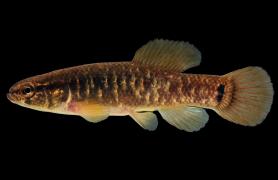 | Central Mudminnow Umbra limi Mudminnows are a small family of only six species and are most closely related to the pikes. This is the only mudminnow that occurs in our state, and it is rare, occurring only in a few marshy locations near the Mississippi River. |
 | Crystal Darter Crystallaria asprella This pale, very slender darter is Endangered in Missouri. Formerly known from many river drainages in the east-central and southeastern parts of our state, it apparently now lives only in the Gasconade and Black rivers. |
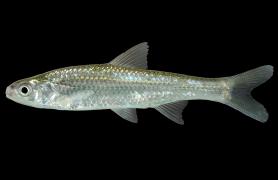 | Cypress Minnow Hybognathus hayi Missouri’s Bootheel lowlands are unlike any other place in the state, and many of the animals and plants that live there occur nowhere else within our borders. The cypress minnow, like the habitat it prefers, is in danger of vanishing from Missouri. |
 | Flathead Chub Platygobio gracilis This active, big-river fish formerly occurred along the entire length of the Missouri River. In the 1940s, it constituted 31 percent of all small fishes in the Missouri River! By the early 1980s, that figure was 1.1 percent. Today, it has all but vanished from our state. |
 | Goldstripe Darter Etheostoma parvipinne One of the rarest darters in our state, the endangered goldstripe has exacting habitat requirements: It needs small, shallow, shaded, spring-fed streams with clear water and a low to moderate gradient. What it doesn’t need is siltation, pollution, channel restriction and removal of the tree canopy above! |
 | Grotto Sculpin Cottus specus A rare fish adapted cave conditions, the grotto sculpin used to be considered simply a different form of banded sculpin. It has recently been designated an endangered species under the Federal Endangered Species Act. It's found only in Perry County, Missouri. |
 | Harlequin Darter Etheostoma histrio In Missouri, this rare darter is found only in our southeastern lowlands. It lives in flowing streams and ditches with sandy bottoms among logs, sticks and other organic debris. It is State Endangered because its small numbers and limited range make it vulnerable to extirpation. |
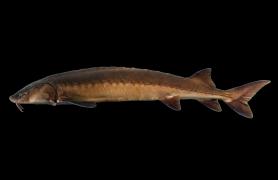 | Lake Sturgeon Acipenser fulvescens The largest of Missouri’s three sturgeons is rare and endangered in our state. One way to identify it is by its conical (not shovel-nosed) snout. And despite its name, in our state this fish is almost always found in big rivers—not lakes. |
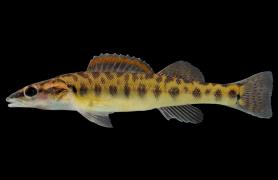 | Longnose Darter Percina nasuta The next time you are enjoying the waters of Table Rock Lake, remember the longnose darter, which used to inhabit the White River when it still flowed through that area. This is why it’s important to protect this Endangered darter’s few remaining streams from sedimentation and pollution. |
 | Mountain Madtom Noturus eleutherus This small catfish is rare and endangered in Missouri. It has been recorded from only a few locations in the southeastern portion of the state. |
 | Neosho Madtom Noturus placidus This endangered species is the smallest catfish in Missouri, where it lives under rocks in riffles or runs, in the clear water of Spring River in Jasper County. |
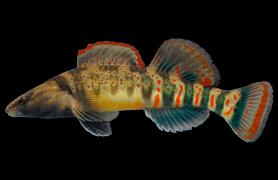 | Niangua Darter Etheostoma nianguae Two small, jet-black spots at the base of the tail fin distinguish this small fish from the more than 30 other darters found in our state. Known from only a few tributaries of the Osage River, this dainty and colorful fish is a nationally threatened species. |
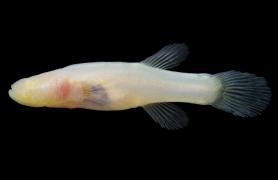 | Ozark Cavefish Amblyopsis rosae This small, colorless, blind fish lives its entire life in springs, cave streams and underground waters. It has been declared Endangered in our state and as Threatened by the U.S. Fish and Wildlife Service. |
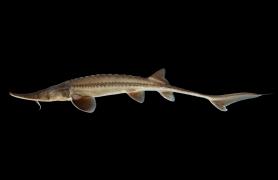 | Pallid Sturgeon Scaphirhynchus albus Similar to shovelnose sturgeon, but with a longer and more pointed snout. Bases of the inner barbels are weakly fringed, and the base of an inner barbel is less than half the width of the base of an outer barbel. |
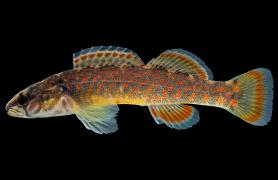 | Redfin Darter Etheostoma whipplei The redfin darter is of the rarest darters in Missouri and is endangered in our state. It is part of a highly distinctive fish community living in the lower Spring River and its North Fork, in Jasper and Barton counties. |
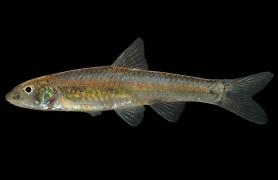 | Sabine Shiner Notropis sabinae Missouri’s southeastern lowlands are home to a fantastic array of plants and animals found nowhere else in the state. The Sabine shiner is one of them—in Missouri, it’s known only from a short stretch of the Black River in Butler County. |
 | Spring Cavefish Forbesichthys agassizi This is the only cavefish in our state that has eyes, however small, and whose body is yellowish-brown or brown; our other cavefishes lack eyes entirely and are pale and nearly colorless. |
 | Swamp Darter Etheostoma fusiforme Darters usually prefer the swift, clear waters of streams and riffles, but this darter is different. True to its name, it prefers swamps and sloughs with no current at all. Rare in our state, it’s found only in a few southeast Missouri locations. |
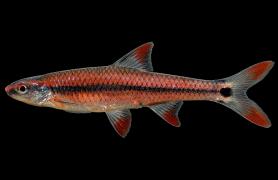 | Taillight Shiner Notropis maculatus One of the rarest Missouri minnows, the taillight shiner is known only from a few localities in Southeast Missouri—in habitats representing the last remnants of low-gradient streams and swamps that once characterized that region. |
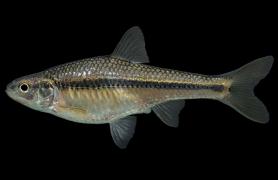 | Topeka Shiner Notropis topeka Currently found in only a few Missouri streams, the Topeka shiner is an endangered native minnow that has declined precipitously because of environmental pollution, siltation, and loss or alteration of habitat. |
Live Bait Regulations
Live Bait Species
Live bait includes crayfish, freshwater shrimp, southern leopard frogs, plains leopard frogs, cricket frogs, and nongame fish. Bullfrogs and green frogs taken under season limits and methods also may be used as bait.
- Common carp, grass carp, bighead carp and silver carp may not be used as live bait but may be used as dead or cut bait.
- Live bait taken from public waters of Missouri may not be sold or transported to other states.
- Game fish or their parts may not be used as bait.
Methods
- Live bait may be taken by trap, dip net, throw net, pole and line or seine.
- Live-bait traps must have a throat opening not more than 1-1/2 inches in any dimension, and must be labeled with the user’s full name and address, or Conservation Number.
- Traps must be removed if they cannot be checked at least once every 24 hours.
- Seines must not be more than 20 feet long and 4 feet deep, with a mesh of not more than 1/2 inch bar measure.
- Live bait, except fish, may be taken by hand.
- Crayfish also may be taken by trap with an opening not to exceed 1-1/2 inches by 18 inches.
Length Limits
- All bluegill, green sunfish and bullheads more than 5 inches long and other species of nongame fish more than 12 inches long must be returned to the water unharmed immediately after being caught by any of the methods listed above except pole and line. The daily limits for nongame fish apply to the large fish taken by pole and line.
- There is no length limit on bighead carp, common carp, gizzard shad, goldfish, grass carp and silver carp when used as bait.
Seasons
Live bait may be taken throughout the year.
Daily Limit
- A combined total of 150 crayfish, freshwater shrimp and non-game fish.
- 5 each of southern leopard frog, plains leopard frog and cricket frog.
- A combined total of 8 bullfrogs and green frogs. Bullfrogs and green frogs may be taken only from sunset June 30 through Oct. 31.
- Any number of goldfish and bighead, common, grass and silver carp.
- Any number of live bait, when purchased or obtained from a source other than the waters of the state or a licensed commercial fisherman; must be species on the Approved Aquatic Species List and angler must carry a dated receipt for the bait.
Other Species That May be Used as Bait
- Nongame fish of any size, except bowfin, if taken according to the non-game methods and seasons.
- Mussels and clams legally taken by sport fish methods.
Possession and Length Limits
Daily and Possession Limits
You may possess no more than the daily limit of any given species while you are on waters, or on the banks of waters, where daily limits for those species apply. Any species taken into actual possession, unless released unharmed immediately after being caught, shall continue to be included in the daily limit of the taker for the day.
Where only catch-and-release fishing is allowed, fish must be returned unharmed immediately to the water after being caught.
The possession limit is twice the statewide daily limit. Fish you take and possess must be kept separate or distinctly identifiable from fish taken by another person. If you are away from your catch, the device holding the fish must be plainly labeled with your full name and address.
Length Limit Definitions
Many fish species and fishing areas have length limits.
A minimum length limit means that fish below a designated length must be returned to the water unharmed immediately after being caught.
A slot length limit or protected length range means that fish within a designated length range must be returned to the water unharmed immediately after being caught.
A maximum length limit means that fish above a designated length must be returned to the water unharmed immediately after being caught.
Regardless of where taken, fish that are not of a legal length cannot be possessed on the waters or banks where length limits apply. The head and tail must remain attached to the fish while you are fishing on waters where length limits apply.
Learn how to measure fish correctly.
Possessing, transporting, and storing fish
The fish you catch in Missouri, or elsewhere, may be possessed and transported as your personal baggage, if you have the required permit. Fish may be stored, preserved or refrigerated only at your home, camp, place of lodging or in a commercial establishment. Stored fish must be labeled with your full name, address, permit number, species of fish and the date placed in storage. Fish taken in another state by methods not permitted in Missouri may not be possessed on waters of the state.
Fish Measuring and Identification
Learn to measure and identify the fish and other aquatic life you catch so you can abide by Missouri's seasons, daily limits, length limits, and other regulations. When in doubt a fish's identity or legal length, play it safe, and return the fish to the water unharmed immediately.
How to Measure a Fish

Total length is measured from the tip of the snout to the end of the tail, with the fish laid flat on the ruler, with the mouth closed and the tail lobes pressed together.
Measure a Paddlefish

Paddlefish are measured from the eye to the fork of the tail.
Measure a Shovelnose Sturgeon
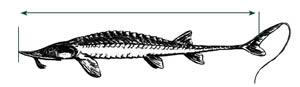
Sturgeon are measured from the tip of the snout to the fork of the tail. Only shovelnose sturgeon are legal to keep.
Missouri Game Fish
| Common Name | Scientific Name | Family |
|---|---|---|
| Black Crappie | Pomoxis nigromaculatus | Sunfish |
| Blue Catfish | Ictalurus furcatus | Catfish |
| Brown Trout | Salmo trutta | Trout |
| Chain Pickerel | Esox niger | Pike |
| Channel Catfish | Ictalurus punctatus | Catfish |
| Flathead Catfish | Pylodictis olivaris | Catfish |
| Goggle-eye (Northern Rock Bass) | Ambloplites rupestris | Sunfish |
| Grass Pickerel | Esox americanus | Pike |
| Largemouth Bass | Micropterus salmoides | Sunfish |
| Muskellunge | Esox masquinongy | Pike |
| Northern Pike | Esox lucius | Pike |
| Paddlefish | Polyodon spathula | Paddlefish |
| Rainbow Trout | Oncorhynchus mykiss | Trout |
| Sauger | Sander canadensis | Perch |
| Shovelnose Sturgeon | Scaphirhynchus platorynch | Sturgeon |
| Smallmouth Bass | Micropterus dolomieu | Sunfish |
| Spotted/Kentucky Bass | Micropterus punctulatus | Sunfish |
| Striped Bass and Hybrids | Morone saxatilis | Temperate Bass |
| Walleye | Sander vitreus | Perch |
| Warmouth | Lepomis gulosus | Sunfish |
| White Bass, Yellow Bass, and Hybrids | Morone chrysops | Temperate Bass |
| White Crappie | Pomoxis annularis | Sunfish |
Culling
Any fish you catch is included in your daily limit unless you release it unharmed immediately. You may not replace smaller fish in your possession with larger ones caught later. You need to make a keep-or-release decision as soon as the fish is caught.
There is one exception: if, from September through June, you are a participant in a bona fide catch-and-release black bass tournament (one after which all bass are released alive) that requires entrants to have a boat livewell with adequate capacity and a pump constantly adding fresh or recirculating water, the black bass you release unharmed from the livewell need not be included in your daily limit. At no time may the daily limit be exceeded.
Alabama Rig Regulations
The Alabama, umbrella and similar rigs may be fished in Missouri so long as they use only three lures or baits. The remaining attachment points can include similar baits so long as their hooks have been removed or other hook-less attractors such as spinner blades are used. This rig is intended to be fished using a rod and reel.
The Alabama rigs we have seen have more than three wires and attachment points. These rigs may be used but only with up to three hooks. (Each bait or lure counts as a hook.) The additional wires and attachment points can be used. However, whatever is attached may not include a hook. You may also clip the extra wires and attachment points off or not use them at all.
Examples of allowed Alabama rigs

This is a standard Alabama rig “modified” to meet the Missouri Wildlife Code. Note that two of the baits have had the hook removed to meet the three-hook limit.
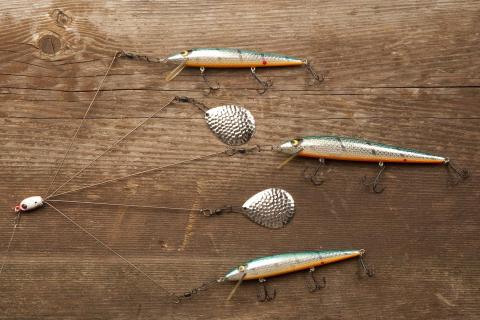
This rigging is consistent with the Wildlife Code. Each lure is considered one hook by Wildlife Code definition. Spinner blades were added as attractors to the “extra” attachment points.

This is a collection of hooks you typically find on the sporting good rack.

Any one of these lures used independently is considered "one hook" by definition in our Missouri Wildlife Code.
Examples of prohibited Alabama rigs
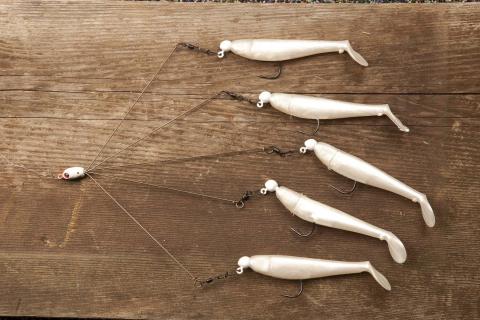
This rigging would NOT be legal in Missouri. You cannot fish five hooks on a pole and line. To comply with the Code, you would need to clip the hooks off two of the baits, OR remove and replace two of the hooked baits with hookless baits or attractors.
Maximum number of poles and hooks
Anglers must not have more than three 3 unlabeled poles and not more than 33 hooks in the aggregate, for any or all fishing methods.
On the Mississippi River, an angler may not have more than 2 unlabeled poles and not more than 50 hooks in the aggregate at one time. While fishing concurrently on the Mississippi River and other Missouri waters, not more than 50 hooks in the aggregate may be used and not more than 33 of those hooks may be used in waters other than the Mississippi River.
While the absolute total number of hooks is either 33 or 50, depending on whether you or not you are fishing on the Mississippi River, you may not use more than 3 hooks per pole.
Definitions
Pole and line: Fishing methods using tackle normally held in the hand, such as a cane pole, casting rod, spinning rod, fly rod, or ice fishing tackle commonly known as a tip-up, to which not more than 3 hooks with bait or lures are attached. This fishing method does not include snagging, snaring, grabbing, or trotlines or other tackle normally attached in a fixed position (rule 3 CSR 10-20.805 (44) in the Wildlife Code).
Hook: Single- or multiple-pronged hooks and the ordinary artificial lures with attached single- or multiple-pronged hooks and dropper flies. A multiple-pronged hook or 2 or more hooks employed to hold a single bait, shall be considered a single hook in counting the allowable total in use (rule 3 CSR 10-20.805 (30) in the Wildlife Code).
Rule 3 CSR 10-6.410 (Fishing Methods) sets the number of poles and hooks.
The current interest in the use of Alabama rigs is noteworthy. Some of the conversations would lead one to believe they are always fish magnets. Time will tell. Plastic worms and electronic fish finders have not produced negative impacts to our bass populations. Fortunately, we have length and daily limits to protect such sport fisheries. We will continue to monitor the use of Alabama and similar rigs and will take action should it be warranted. In the meantime, we will appreciate the excitement this new rig has brought to fishing.
Handfishing Prohibited
Handfishing, or noodling, is a method of reaching underwater into natural cavities formed in riverbanks or by tree roots, logs, or rocks and capturing a catfish by hand. When the catfish bites onto the hand, the noodler pulls the fish off the nest and out of the water. This method is primarily used to catch flathead catfish and blue catfish in Missouri when these fish are spawning or nesting in small rivers or streams.
In Missouri, flathead and blue catfish are valued as a top game fish and are therefore regulated under the state’s Wildlife Code.
While some other states allow hand-fishing for catfish, most classify one or more catfish species as non-game fish.
Surveys show that hand-fishing tends to be highly successful. Because of its high success rate and focus on removing larger, older, sexually mature fish from their nests, research shows that legalizing hand-fishing could jeopardize local populations of this popular game fish.
Catfish are very vulnerable during the nesting season (June and July) because they lay their eggs in natural cavities and then do not leave the nest. If they’re taken away, their eggs quickly die. Catfish on the nest are not vulnerable to being caught by traditional sport-angling methods.
Our research shows that less than 25 percent of catfish migrate from large rivers to smaller tributaries (depending on seasonal water levels). Hand-fishers have easy access to these smaller wading streams and the nesting cover catfish use, making these catfish especially vulnerable. A survey of hand-fishers conducted by the University of Missouri–Columbia Department of Parks, Recreation and Tourism reported that 90 percent of hand-fishers prefer to fish in smaller rivers or streams, which are most vulnerable to over-harvesting.
Jug Line Regulations
Check anchored jug lines daily; ensure the anchor is secure
Anchored jug lines may not be left unattended for more than 24 hours.
The anchor must be sufficient to render a jug immobile so that wind, current, or large fish will not move the jug. A line that does not meet this standard is considered unanchored. Under normal fishing conditions, a 2-pound weight for a 2-liter soda bottle would be an appropriate anchor. Use a heavier weight to anchor larger floats or during times of high wind and current.
Closely attend unanchored jug lines
Keeping track of your unanchored jug lines reduces catfish waste and jug-line litter. Unanchored jug lines in streams must be personally attended at all times. Unanchored jug lines in lakes must be personally attended at least once per hour. Personally attended means that the angler whose name is labeled on the jug line:
- Is in visual sight of and close proximity to the jug line
- Can see the jug line bob and move when a fish is hooked and can retrieve it
- Can see and talk to a conservation agent checking the line
- Can get the attention of or deter anyone who is tampering with the jug line.
Anglers who cannot personally attend their jug lines can still enjoy jug fishing by using anchors.
Label your jug lines
You must place a tag of a durable material with your full name and address or Conservation Number on each jug line. Your Conservation Number is nine digits long and can be found on your fishing permit or on the back of your Heritage Card.
Porous-Soled Waders Ban
Didymo is an invasive alga that can lodge in porous-soled waders.
Porous-soled waders include shoes, boots, or waders with porous soles made of felt or any matted or woven fibrous material.
To keep didymo from invading trout waters, porous-soled waders are prohibited on the following waters:
Trout Parks
- Maramec Spring Park
- Bennett Spring State Park
- Montauk State Park
- Roaring River State Park
Lakes and Streams
- Barren Fork Creek in Shannon County
- Blue Springs Creek in Crawford County
- Capps Creek in Barry and Newton counties
- Crane Creek in Stone and Lawrence counties
- Current River in Dent, Texas, and Shannon counties
- Dry Fork Creek in Crawford and Phelps counties
- Eleven Point River in Oregon County
- Hickory Creek in Newton County
- Lake Taneycomo and its tributaries in Taney County
- Little Piney Creek in Phelps County
- Meramec River in Crawford and Phelps counties
- Mill Creek in Phelps County
- Niangua River in Dallas and Laclede counties
- North Fork of White River in Ozark County
- Roaring River in Barry County
- Roubidoux Creek in Pulaski County
- Spring Creek in Phelps County
- Stone Mill Spring Branch in Pulaski County
Black Bass, Stream Restrictions
Streams With Possession Open Year-Round
Black bass fishing and possession is open year-round on the Mississippi River, all waters north of the south bank of the Missouri River, the St. Francis River downstream from Wappapello Dam, and on streams in that portion of southeast Missouri bounded by a line from Cape Girardeau following Missouri highways 74 and 25, U.S. highways 60, 67, and 160; and the west bank of the Little Black River to the Arkansas sate line.
Streams With Catch-and-Release Part of the Year
In the rest of the state, black bass from streams may not be possessed March 1 - May 26, 2023. Only catch-and-release fishing for black bass is allowed during this time in this area of the state.

Possession Requirements for Sturgeon and Paddlefish Eggs
- Extracted paddlefish and shovelnose sturgeon eggs may not be possessed while on waters of the state or adjacent banks and may not be transported.
- Shovelnose sturgeon must remain intact while on waters of the state or adjacent banks.
- Paddlefish eggs may not be bought, sold, or offered for sale.
Commercial Shovelnose Fishing Restricted

In a nationwide effort to protect declining populations of the federally endangered pallid sturgeon, the U.S. Fish and Wildlife Service (USFWS) ruled in early October 2010 that shovelnose sturgeon must be treated as a threatened species under the Endangered Species Act because of their similarity in appearance to the pallid sturgeon.
This action terminates the commercial harvest of shovelnose sturgeon and shovelnose-pallid sturgeon hybrids where they commonly coexist with the pallid sturgeon or where their ranges commonly overlap. Under this federal ruling, sturgeon caught by commercial methods in these areas must be immediately released with all roe (eggs) intact. The ruling does not apply to sport fishing.
As a result of this federal ruling, the harvest of the flesh or roe of shovelnose sturgeon and shovelnose-pallid sturgeon hybrids by commercial fishing methods is prohibited in Missouri in the entire Missouri River and in the Mississippi River below Melvin Price Locks and Dam near Alton, Ill.
MDC fisheries biologist Craig Gemming describes some of the main physical characteristic differences between the pallid, shovelnose, and lake sturgeon.
Live Bait Dealer Regulations
- Any person, group or business that sells live bait, as defined in 3 CSR 10-6.605 of the Wildlife Code of Missouri, must register annually with the department as a live bait dealer.
- Live bait may not be sold if obtained from the waters of the state except when taken by a licensed commercial fisherman from commercial waters. Live bait purchased or obtained from a licensed commercial fisherman or other legal sources must be species listed in the Approved Aquatic Species List.
- Only the Virile (or “Northern”) crayfish (orconectes virilus) may be purchased for re-sale or sold for use as live bait. Live Virile (“Northern”) crayfish may not be imported into the state.
Live bait obtained as described in this rule may be possessed in any number.
Don't spread crayfish.
Trespassing
Paddlers and anglers often ask whether they have a legal right to use Missouri’s streams. The answer is yes … in some places and in some ways.
Missouri’s rivers and streams can be classified as:
- Public, navigable — Large rivers on which commercial boats such as barges can navigate.
- Public, non-navigable — Middle-sized streams that are capable of floating smaller boats such as canoes.
- Private, non-navigable — Small streams that are not capable of floating even small boats such as canoes.
On private, non-navigable streams, adjacent landowners’ property extends to the center of the stream. Consequently, anglers and floaters have no right to use these streams. Fishing, wading, and boating are illegal unless you have the landowner’s permission.
On public, non-navigable streams, property lines are the same as they are on private, non-navigable streams. The difference is that although you are on private property, you have a right to use public, non-navigable streams for fishing, wading, or boating as long as you stay within the stream bed. The stream bed includes gravel bars that are submerged during part of the year.
The stream bed begins at the high-water mark. In practical terms, this is the point where trees and other permanent vegetation grow. Floaters and anglers need landowner permission to go beyond this point.
On public, navigable streams, property lines end at the high-water mark. The area inside the high-water marks is public property.
Although all of this may seem clear-cut, opinions can vary dramatically about how to classify a particular stretch of stream and where the high-water marks lie. Furthermore, permanent islands in public, navigable and public, non-navigable streams often are private property.
The local prosecuting attorney is your best reference to determine how a particular stretch of a stream is classified and where to find nearby public accesses. The county assessor’s office can tell you where the property lines are. When in doubt, always ask for permission from the landowner.
