

Ice Fishing
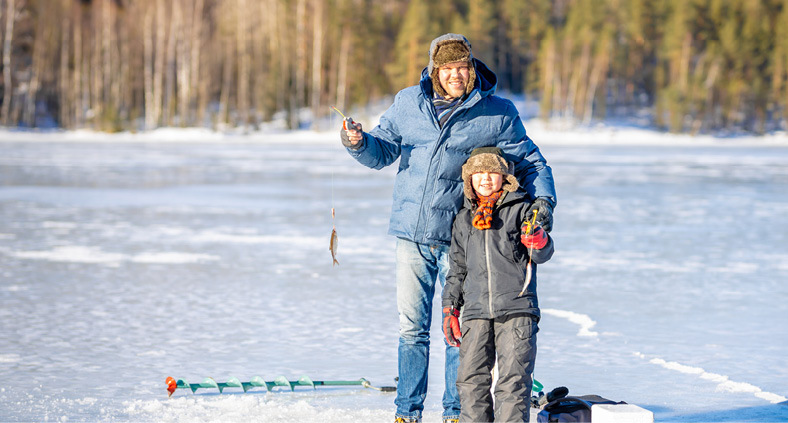
Get Your Family Excited About Going Ice Fishing!
Whether you’re fishing for trout, bass, crappie, or perch, ice fishing is a great way to spend a winter day.
A few basic preparations can make your ice-angling adventure a day to remember.
Ice fishing equipment is specialized but simple. You need a sled for moving equipment onto the ice—a big plastic boat sled can haul your gear or a tired child. A homemade sled works great, too; try a wooden box attached to a pair of old downhill skis.
A “spud” can be used to test the thickness of the ice, to make holes in the ice, or to re-open holes made by someone else. An auger is a giant drill for making holes in the ice; get a hand auger for the exercise, or a power auger to make lots of holes in a hurry. Use a “skimmer”—a long-handled slotted spoon—to remove slush and ice from your ice-fishing holes.
The most popular ice-fishing device is the “tip-up.” The reel, spooled with several hundred feet of braided line, is submerged in the water; the rest of the device is suspended on the ice by a pair of crossed “arms.” A simple triggering mechanism makes a flag pop up when a fish takes the bait, at which point you pull the device from the water and reel the fish in by hand.
Your bait will usually be near the bottom, so you’ll want a “sounder” to know how far down the bottom is. A sounder is a heavy metal weight with a clip that attaches to your hook or line. Lower it into the hole, and take the guesswork out of how deep to fish. Mark your line with a button or small sinker, and you won’t have to re-sound after catching a fish or changing bait.
For a more active ice-fishing experience, try a jig rod—like a regular spinning outfit with a short (2-to 3-foot) rod. Jig rods are named for the up-and-down “jig” motion the angler gives the bait or lure. They allow you to fish throughout the water column.
You’ll Need Bait
Live shiners are the bait of choice, and are sold in many locations. You will need a bait bucket for them, and a bait dipper, which is a small net to retrieve the little rascals from the cold water. Mealworms and maggots are best baits for sunfish and crappies.
What to Wear
A good pair of insulated boots, heavy wool socks and long johns are musts. A fleece layer is next—or perhaps the traditional wool pants and shirt. Your outer layer needs to be windproof and waterproof; snow pants and a good winter coat will do the trick. Layering will give you and your family better protection and comfort in the cold. Don’t forget a warm hat and insulated gloves.
Bring Snacks
Snacks and drinks are very important for keeping your energy up on the ice. Fill a thermos with beef stew or mac and cheese, and another with hot cocoa.
Other Gear
A small tackle box carries other items you shouldn’t be without—hooks, spare sounders, non-lead sinkers, lures, jigs, a first-aid kit, pliers and trash bags. For safety and comfort, also bring rope (15 feet), extra clothing (leave in vehicle), a compass, fire starter and matches, a folding lawn chair or pack chair, a heavy blanket, and those handy little instant-heat packets. Consider ice crampons or “creepers” for walking on ice.
Ice fishing is the main focus of the trip, but there is some waiting involved; having activities to keep busy and warm will only add to the fun. Frisbee, wildlife tracking, snow-fort building and skating are favorites. Time of day doesn’t matter, so plan your trip around the warmest part of the day, and keep it short to start. You don’t have to go far from home to have a good time ice fishing. Let’s face it—New Hampshire winters can seem a little long. Having an activity to look forward to makes them much more fun. Enjoy your winter on the ice!
General Rules
Ice fishing in most New Hampshire lakes and ponds begins at “ice-in” and ends at “ice-out.” Depending on the weather and ice safety, this “season” can be from late December through mid-April. These types of waters support mostly warmwater fish populations, including perch, pickerel, black crappie and bass, with a few waters providing opportunities to catch brook, rainbow or brown trout through the ice. For specific bag limits for certain species, see Lakes & Ponds: General Rules. Waters managed for lake trout and/or salmon have a defined ice fishing season of January 1 through March 31. Remember—salmon may not be taken through the ice. Designated trout ponds are closed to ice fishing.
On most New Hampshire waters, the general rule is 6 ice fishing devices (lines) per person when ice fishing, with the following exceptions:
- Ice anglers are limited to 5 lines while ice fishing on N.H.-Maine border waters, except Great East Lake, which has a 2-line limit.
- Only 2 ice fishing devices (lines) per angler are allowed when fishing the designated lake trout and salmon lakes listed below (see exceptions under Cusk Fishing).
Note on Interstate Waters: See Interstate Waters for additional rules for ice fishing on interstate waters.
Hooks used for bait while ice fishing must have only a single hook with a single hook point per ice fishing device.
Waterbody |
Managed for Lake Trout |
Managed for Landlocked Salmon* |
Connecticut Lake, First |
• |
• |
Connecticut Lake, Second |
• |
• |
Connecticut Lake, Third |
• |
|
Conway Lake |
• |
|
Dan Hole Pond, Big |
• |
• |
Diamond Pond, Big |
• |
|
Francis Lake |
• |
• |
Granite Lake |
• |
|
Great East Lake |
• |
|
Greenough Pond, Big |
• |
|
Merrymeeting Lake |
• |
• |
Newfound Lake |
• |
• |
Nubanusit Lake |
• |
• |
Ossipee Lake |
• |
|
Silver Lake (Harrisville) |
• |
|
Silver Lake (Madison) |
• |
|
Squam Lake, Big |
• |
• |
Squam Lake, Little |
• |
• |
Sunapee Lake |
• |
• |
Winnipesaukee Lake |
• |
• |
Winnisquam Lake |
• |
• |
Bob Houses
Bob houses must be removed from public waters, public property or private property no later than April 1. The owner’s name and address shall be plainly marked on the bob house and shall have 12 square inches of reflective material half-way up on the outside of each side.
Cusk Fishing
Freshwater cusk (burbot) may be taken through the ice with a cusk fishing device (see definition on Definitions) marked with the name and address of the user. In addition to the normal number of lines allowed (see line limits above), up to 6 cusk fishing lines may also be used. Any species other than cusk caught on a cusk line must be released immediately by cutting the line without removing the fish from the water.
The sinker of the cusk fishing device must rest on the bottom of the waterbody. Through the ice, cusk fishing devices will be permitted to be set and left unattended, except once during each 24-hour period, the bait end of the line must be inspected. “Bobbing,” “jigging,” or movement of the bait to attract fish is prohibited.
The use of cusk fishing devices is restricted to the following waters: First Connecticut Lake (Pittsburg), Second Connecticut Lake (Pittsburg), Third Connecticut Lake (Pittsburg), Lake Francis (Pittsburg), Lovell Lake (Wakefield), Merrymeeting Lake (New Durham), Newfound Lake (Bristol, Alexandria, Bridgewater, Hebron), Ossipee Lake (Freedom/Ossipee), Silver Lake (Madison), Big Squam Lake (Holderness, Center Harbor, Sandwich, Moultonboro), Little Squam Lake (Holderness, Ashland), South Pond (Stark), Sunapee Lake (Newbury, New London, Sunapee), Waukewan Lake (Meredith), Wentworth Lake (Wolfboro), Lake Winnipesaukee (Alton, Center Harbor, Gilford, Laconia, Meredith, Moultonboro, Tuftonboro, Wolfeboro), and Winnisquam Lake (Belmont, Sanbornton, Laconia, Tilton, Meredith).
Safety on Ice
Is the ice safe? You won’t know until you test it. Use a chisel or “spud” to thump the ice as hard as you can; if it does not break through, continue onto the ice. Make a test hole to check the thickness where you hit, and check the ice at intervals on your way out to your fishing spot.
Generally speaking, solid, clear ice of 5 to 6 inches is adequate for small groups; ice thickness of 8 inches and up is good for large groups. Be aware that ice can be weakened by objects frozen into it, because they hold the heat from the sun; avoid docks, large rocks and trees fallen onto the ice. Also avoid areas with springs or moving water under the ice. Visit wildlife.nh.gov/get-outside/stay-safe-ice to learn more.