
Hunting Access on Private Lands
WDFW Private Lands Program
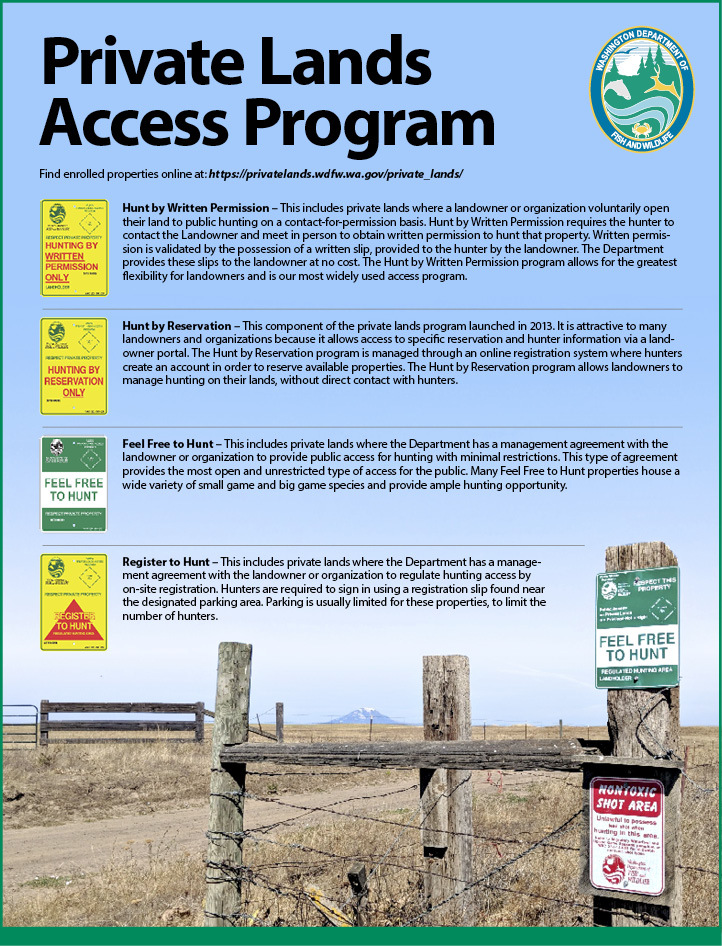
The Washington Department of Fish and Wildlife Private Lands Program was developed to restore and enhance important habitat for wildlife, and to increase public recreational access to private property. WDFW Private Lands Biologists across the state provide technical assistance to private landowners to improve wildlife habitat, promote public support for wildlife, and increase public hunting and recreational opportunities in the WDFW Private Lands Access Program.
Private lands enrolled in the Private Lands Access Program are available to hunters at no cost for access. In 2020, WDFW was awarded a federal Voluntary Public Access (VPA-HIP) grant to assist in ongoing enrollment efforts and program support. Each year, new properties and opportunities are added. Statewide, there are more than 500 private landowners and over 1.8 million acres enrolled in public access and habitat development agreements. Be aware property listings can change. Hunters should check frequently for updates before the season starts. Visit the hunting access page of WDFW’s website at:
If you are a private landowner interested in learning about landowner incentives and flexible options for program enrollment, please contact a Private Lands Biologist in your region. For information visit:
Hunters are Feeling the Pinch of Reduced Access
Despite the efforts of WDFW, private lands available for public access has declined over time. Several major landowners now charge fees for public access. This is increasingly common across the state but especially in western Washington where large timberland owners have begun to charge access fees and limit the number of hunters.
Decreasing land available for public hunting is increasing hunting pressure on public lands. These crowded conditions on public land along with the cost of fee to access alternatives are limiting hunter participation at a time when it is imperative to retain and recruit new hunters and recreational enthusiasts.
Hunters should be aware that private landowners charging fees for land access has expanded over the past year and are known to impact access in the following Game Management Units: 418,437, 448, 460, 501, 506, 520, 524, 530, 550, 556, 564, 568, 574, 578, 602, 603, 612, 615, 638, 642, 648, 651, 653, 654, 658, 660, 667, 672, 673, and 681. Substantial blocks of land in these areas are leased or require hunters to purchase permits to access private timberlands.
WDFW has and will continue to seek new approaches and encourage other landowners to keep access fees reasonable and hunter number restrictions flexible.
Access to Private Lands is a Privilege
Most hunting in Washington occurs on private forest and agricultural lands. WDFW works with landowners to maintain access but many other landowners provide access without direct assistance from WDFW. Hunters can help maintain privileged access by respecting the landowner and following their rules.
- Obey all posted signs
- Leave gates as you found them
- Pack out your trash
- Be courteous
- No camping
- No ORV’s
- No fires
- Drive only on maintained roads if open to motorized access
- An opened gate does not mean the road is open to motorized access, again read the signs
- If possible, avoid active haul routes, logging operations and farming operations
- Private forest lands and agricultural lands are usually closed to public access during hours of darkness.
- No target shooting or plinking
- No wood cutting
- Respect Fire Danger Closures
- Don’t block gates
- Carry water, shovel, ax etc.
Landowners may not have staff on hand to answer all hunting access related calls. Some have hotlines or websites with access information. Hunters are encouraged to contact WDFW regional offices or Private Lands Biologists directly about access to private lands prior to contacting the landowner. A map with the Private Lands Biologists contact information can be found at: