

Statewide Limits & Regulations
Statewide Creel and Length Limits |
||
The following are the creel and size limits that apply statewide. Several waters have exceptions to these limits. Refer to the pages listed in red at the bottom of this page to see exceptions to the statewide regulations. If you are fishing a location that does not have exceptions listed in this guide, then the statewide limits apply. |
||
Species |
Creel Limit |
Minimum Length Limit |
Black Bass (includes Largemouth, Smallmouth, Spotted, Alabama, and Coosa) |
5 |
none |
Crappie (all species combined) |
15 |
10 inches |
Region 1 Crappie Exception: unless otherwise noted for specific waters. |
30 |
none |
Rock Bass or Redeye and Shadow Bass |
20 |
none |
Striped Bass or Hybrid Striped Bass |
2 |
15 inches |
White Bass |
15 |
none |
Muskellunge |
1 |
36 inches |
Sauger or Sauger/Walleye hybrids |
10 |
15 inches |
Walleye |
5 |
16 inches |
Trout (all trout species combined) |
7 |
none |
Lake Trout |
Only 2 trout may be lake trout. |
none |
Redear Sunfish or Shellcracker |
20 |
none |
Yellow Bass, Bluegill, Warmouth, Bream, Bullheads, Pickerel, Northern Pike, |
no limit |
none |
Skipjack Herring |
100 |
none |
Alligator Gar: No harvest allowed. Must be returned to water immediately. |
||
Catfish: Only one catfish over 34 inches may be harvested per day. No harvest limit on catfish less than 34 inches. |
||
Paddlefish: Paddlefish may be harvested from April 24 through May 31. Daily creel limit is 2 fish per day with no size limit. Culling is prohibited. For exceptions on Center Hill, Cherokee, and Watts Bar reservoirs, see Region 3 and Region 4. |
||
Shovelnose Sturgeon: No harvest allowed. Must be returned to water immediately. |
||
Exceptions to the statewide limits and other regulations:
Reservoirs - See Regions pages
TWRA Fishing Lakes - TWRA Fishing Lakes Information
Small Impoundments - Exceptions to Statewide Regulations
State Park Lakes - Exceptions to Statewide Regulations
Streams and Rivers - Exceptions to Statewide Regulations
Trout Fisheries - Trout Regulations
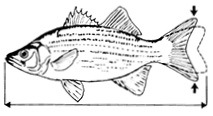
Measuring a Fish's Length
Lay the fish on a flat ruler, close the mouth, and squeeze the lobes of the tail fin to produce the maximum length. The mouth of the fish may not be manipulated or extended.
TWRA’s goal is to manage each species of fish with statewide creel and length limits where possible. However, many waters, because of their unique characteristics, require individual creel and length limits. These regulations improve fishing for all anglers.
Minimum Length Limits restrict the harvest of fish below a specified minimum length. For example, a 15-inch minimum length limit allows the angler to keep fish 15 inches or greater. Fish less than 15 inches cannot be harvested.
Slot Limits or Protected Length Ranges (PLRs) allow anglers to harvest fish above and below a specified length range. For example, a 14–18” PLR protects fish in the 14- to 18-inch length group. Anglers may harvest fish that measure less than 14 inches and they may harvest fish that measure over 18 inches. For a protected length range to be effective, anglers must harvest fish below the protected range.
Possession Limits: The total possession limit is twice the daily creel limit. You may not have more than the daily creel limit with you while afield. It is unlawful to have, while afield, any fish which has been altered so that its species and/or total body length cannot be determined.
Pole or Rod Limit: Unless otherwise noted in this guide or by proclamation, there is no limit on the number of poles an angler may fish at one time.
Statewide Hook Restriction
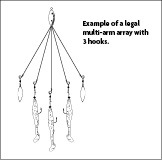
Unless otherwise restricted in this proclamation, anglers are restricted to a maximum of 3 hooks per rod, pole or hand-held line. Single, double or treble hooks each count as one hook. The statewide hook restriction does not apply when using a sabiki rig (also known as a piscatore rig) to take shad or herring. A sabiki rig is a set of small lures attached to a single line, typically used to catch baitfish.
Banned In Tennessee
It is unlawful to possess or transport live specimens of the following animals:
- Silver carp
(Hypophthalmichthys molitrix)
- Bighead carp
(Hypophthalmichthys nobilis)
- Black carp
(Hypophthalmichthys piceus)
- Blueback herring
(Alosa aestivalis)
- Marbled Crayfish (Marmorkreb)
(Procambarus fallax f. virginalis)
- New Zealand mud snail
(Potamopyrgus antipodarum)
- Round goby
(Neogobius melanostomus)
- Rudd
(Scardinius erythrophthalmus)
- Ruffe
(Gymnocephalus cernua)
- Snakeheads
(all members of the Family Channidae)
- Swamp eels
(all members of the Family Synbranchidae)
- Zebra mussels
(Dreissena polymorpha)
