

Falconry
Last Updated: August 19, 2026

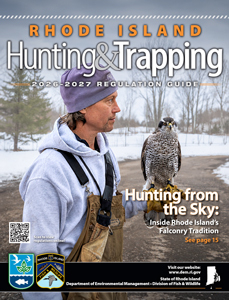
Jim Gwiazdzinski with a goshawk on their way out to hunt. Photo by Charlie Nutting.
Hunting from the Sky: Inside Rhode Island’s Falconry Tradition
By Sarah Riley, Chief Implementation Aide and State Falconry Administrator
Falconry demands far more than acquiring a bird and venturing into the woods for a casual outing. Though it is not a widely known or commonly practiced hunting sport, a dedicated community of falconers in Rhode Island continues to preserve this ancient tradition.
Falconry is defined as the taking of wild quarry with a trained raptor. While this definition is concise, the commitment and discipline required to participate in the practice are anything but simple.
It is a year-round pursuit, with a seemingly endless list of tasks and responsibilities. During hunting season—the pinnacle of the falconry calendar—falconers spend long hours outdoors in all conditions, from sweltering hot September days to sub-zero temperatures in February. Days in the field often involve pushing through waist-high briars, navigating dense woodlots, tracking and retrieving a hunting bird, and occasionally falling into swamps hidden beneath winter snow. Despite the challenges, a successful day ends with a falconer walking out of the woods with their bird on the fist and, if skill and luck align, game in the bag. Obtaining a falconry license is a lengthy and rigorous process that often takes several years to complete. Prospective apprentices must first secure a qualified mentor willing to supervise their training. Because experienced falconers are not always available—or able—to take on apprentices, finding a mentor is often one of the most significant challenges for those seeking to enter the sport. Once a mentor or sponsor has been secured, the prospective falconer must pass the state falconry examination, obtain and construct the required equipment and facilities, and undergo an inspection by the Rhode Island Department of Environmental Management, before submitting a final application. New falconers begin at the Apprentice level. During this stage, they develop and refine their skills under the guidance of a mentor who has practiced falconry for at least three years at the General Class level. Apprentices are permitted to work with one wild-caught red-tailed hawk per season for a minimum of two seasons, and potentially longer if their mentor determines that additional training is necessary. Once a mentor determines that an apprentice has developed the necessary proficiency, the apprentice must complete a field trial demonstrating proper equipment use, safe and effective handling of their bird, field control, and the ability to successfully take game with the hawk. Only after completing this evaluation can they advance to the level of General Class falconer. Once the General Class license is achieved, falconers may work with a variety of other raptor species. Falconers may apply for Master Class status only after at least five years of active practice as a General Class falconer. Advancement requires another field trial demonstrating their skills above that which are required of a General Class falconer, specifically working with multiple types of raptors. In falconry terminology, these groups include “longwings” (falcons), “broadwings” (soaring hawks such as buteos), and “shortwings” (forest hawks such as accipiters). Each group of raptors differs significantly in its natural history, training methods, housing requirements, and hunting applications. A Master Falconer has devoted years to developing the knowledge and expertise required to work successfully with each of these specialized birds.
Photo by Charlie Nutting
Across the United States, the most commonly used raptor in falconry is the red-tailed hawk. Their adaptability, size, and hunting style make them excellent falconry birds. In Rhode Island, they are most often used to hunt rabbits and squirrels, both of which have suitable habitat in the state. Smaller falcons such as the American kestrel and the merlin are frequently used to hunt invasive passerine species, specifically house sparrows and European starlings, which may be taken year-round. Larger falcons, such as peregrine falcons, are often flown on ducks, taking advantage of their remarkable speed and aerial agility. Accipitrine or “forest” hawks—including Cooper’s hawks and goshawks—excel in wooded environments. The goshawk, in particular, is highly revered for its ability to pursue both mammals and birds, including rabbits, squirrels, doves, and ducks. However, their specialized evolutionary adaptations also make them challenging to maintain and train in captivity, requiring the experience and skill of a seasoned falconer. One of the most common questions falconers receive is: what do the raptors gain from this relationship, and why do they remain with their human partners? The answer lies in trust, respect, and a reliable food source. Raptors are generally solitary animals, and working with them requires patience and a deep understanding of how they perceive and interact with their environment. With a strong hunting bond between falconer and bird, trained raptors receive a dependable source of food and protection from many of the threats they face in the wild, including starvation, predation, vehicle strikes, window collisions, domestic animal attacks, and disease. While hunting birds share their prey with their falconers during the active season, they also benefit from a lengthy off-season. During this time, they are provided daily food, safe housing, and the conditions necessary for a healthy molt—the biologically demanding annual process by which they drop and regrow their feathers. The long hours of preparation, training, research, maintenance, and fieldwork are responsibilities falconers willingly accept as stewards of their hunting partners. Although falconry differs significantly from other forms of hunting, it remains a deeply respected tradition among its practitioners. Rhode Island’s falconers represent a small but dedicated community, proud to uphold this historic practice and grateful for the continued support of the Rhode Island Department of Environmental Management in preserving the heritage of traditional hunting.
