Rhode Island

Saltwater Fishing

Saltwater Fishing

Fishing Knots

These and additional fishing knots are available on waterproof plastic cards from the Pro-Knot website.

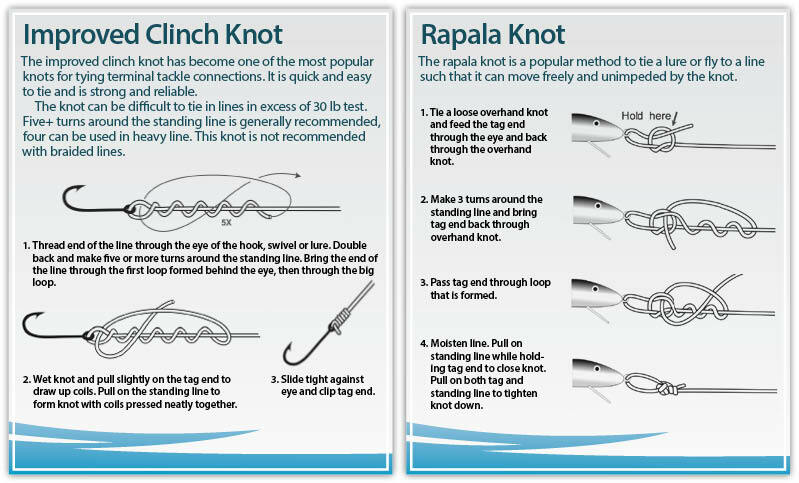
Improved Clinch Knot

The improved clinch knot has become one of the most popular knots for tying terminal tackle connections. It is quick and easy to tie and is strong and reliable.

The knot can be difficult to tie in lines in excess of 30 lb test. Five+ turns around the standing line is generally recommended, four can be used in heavy line. This knot is not recommended with braided lines.

1. Thread end of the line through the eye of the hook, swivel or lure. Double back and make five or more turns around the standing line. Bring the end of the line through the first loop formed behind the eye, then through the big loop.

Step-by-step illustration showing how to tie a fishing hook using the improved clinch knot, with five line wraps around the main line.
Learn to tie the improved clinch knot—a strong, reliable fishing knot ideal for securing hooks to monofilament or fluorocarbon line. Wrap the tag end around the main line at least five times for a secure hold.

2. Wet knot and pull slightly on the tag end to draw up coils. Pull on the standing line to form knot with coils pressed neatly together.

Diagram showing the final step of tying an improved clinch knot to attach a fishing hook to the line, with the tag end threaded through the loop.
The final step of tying an improved clinch knot: thread the tag end through the loop near the hook eye and pull tight. Ideal for securing fishing hooks with strong, reliable tension.

3. Slide tight against eye and clip tag end.

Fishing hook securely tied with an improved clinch knot, showing the finished knot wrapped around the line.
A properly tied improved clinch knot keeps your fishing hook secure and ready for action. Ideal for monofilament and fluorocarbon lines in both freshwater and saltwater fishing.

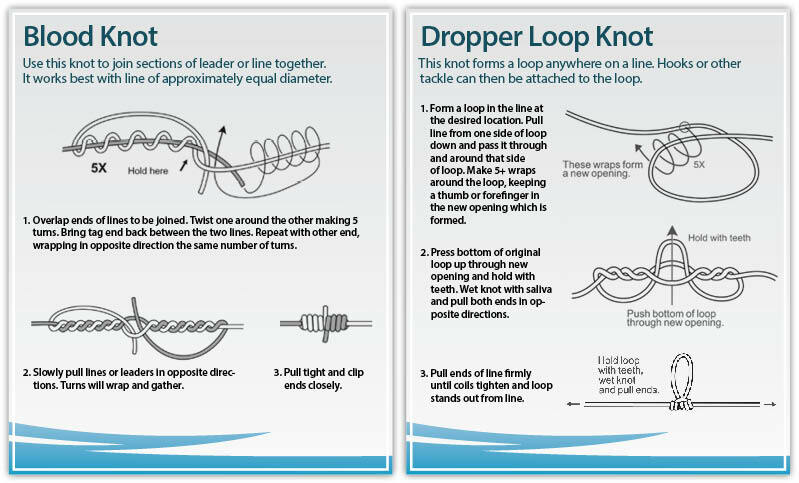
Dropper Loop Knot

This knot forms a loop anywhere on a line. Hooks or other tackle can then be attached to the loop.

1. Form a loop in the line at the desired location. Pull line from one side of loop down and pass it through and around that side of loop. Make 5+ wraps around the loop, keeping a thumb or forefinger in the new opening which is formed.

Fishing line being wrapped five times to form a new opening in the process of tying a dropper loop knot.
To start a dropper loop knot, wrap the line around itself five times to create a new opening. This knot is ideal for attaching additional hooks or rigs in saltwater fishing.

2. Press bottom of original loop up through new opening and hold with teeth. Wet knot with saliva and pull both ends in opposite directions.

Diagram showing how to push the bottom of a fishing loop through the new opening in a dropper loop knot, with instruction to hold the loop with teeth.
To continue tying a dropper loop knot, push the bottom of the loop through the new opening created by the wraps. Hold the loop securely with your teeth before tightening.

3. Pull ends of line firmly until coils tighten and loop stands out from line.

Final step of tying a dropper loop knot, showing the loop held with teeth and instructions to wet the knot and pull both ends to tighten.
To finish the dropper loop knot, wet the line and pull both ends tight while holding the loop with your teeth. This strong knot is perfect for adding extra hooks or rigs to your fishing line.

Illustrations c 2011 John E Sherry