

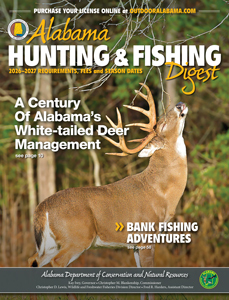
A Century of Stewardship – Whitetailed Deer Management in Alabama
Last Updated: August 12, 2026

The white-tailed deer (Odecoileus virginianus) is Alabama’s most significant game animal with respect to the number of its hunters and resources expended on pursuing them. Considering the abundant deer population we see now, it's difficult to comprehend that there was a time, not long ago, when their presence in our State was nearly gone, primarily due to unregulated commercial and sustenance hunting. By the early 1900s, this lack of regulated harvest had severely reduced deer numbers across Alabama. In many counties, deer were functionally absent. Their populations had been reduced to likely a few thousand individuals and restricted to isolated pockets of river bottomlands in southwest Alabama. Even into the 1950s and later, the sight of a deer track was enough to prompt neighborhood discussion and excitement. Where conservation laws were in place, their impact was minimal because enforcement was virtually nonexistent.
In 1907, the Alabama Legislature addressed concerns about wildlife conservation by appointing the first State Game and Fish Commissioner, John H. Wallace, Sr., to lead the newly formed Department of Game and Fish. Legislation was also passed that vested title and ownership of all wild birds and animals in the state to regulate their use and disposition for long-term sustainability. New statutes also appointed game wardens, specifically to enforce all game and fish laws. With enforcement officers in place, Alabama began actively establishing new laws to protect the state’s natural resources. To address abysmal deer numbers and other conservation interests, new laws included making doe deer illegal game, closing deer season in many counties, setting a daily limit of one buck per day for a season that ran from November 1 through December 31, prohibiting night hunting of deer, requiring hunting licenses for hunting any game bird or animal, and requiring written permits from landowners to hunt on their land.
After new conservation laws and new officers to enforce them were established, the effort transitioned to a hands-on approach of directly supplementing deer populations through restocking. The Alabama Department of Game and Fish began the search for donor sources of white-tailed deer. In 1925, the Department collaborated with the state of Michigan for the first effort, along with the U.S. Forest Service and private residents, to initiate the first successful restocking effort by purchasing 105 deer and released them into the Bankhead National Forest in Winston County. The releases were carefully planned, taking into account available habitat, food sources, and the ability of relocated animals to establish breeding populations. While early techniques were labor-intensive and sometimes experimental by modern standards, they laid the foundation for one of the most successful wildlife restoration efforts in the Southeast. The passing of the Pittman-Robertson Act in 1937 enabled a key transition period with dedicated federal funding that allowed for the hiring of formally trained wildlife biologists to advance the restocking efforts. Subsequent releases continued until the mid-1960’s throughout the state with deer sourced from North Carolina, Michigan, Texas, Arkansas, Wisconsin, Georgia, and multiple locations in Alabama.
Stocked deer adapted quickly to Alabama’s diverse habitats. As populations expanded, regulated hunting seasons were gradually reopened in areas previously closed. Legal harvest allowance frameworks were adjusted as herd numbers increased, ensuring that populations continued to grow while enabling hunters to once again participate in traditional outdoor pursuits.
The success of these efforts relied on more than simply moving animals from one place to another. Habitat management, law enforcement, biological monitoring, and public cooperation all played, and continue to play, essential roles related to the success of this species’ management. Wildlife biologists refine management strategies as deer populations change, balancing herd health, habitat capacity, and hunting opportunity.
The detection of Chronic Wasting Disease (CWD) in Alabama has presented a new management challenge for our agency. As always, we will continue responding appropriately to wildlife population trends and disease concerns by implementing management actions based on the latest research. Our goal is to develop recommendations and regulations that help slow the risk of disease spread while improving our understanding of CWD distribution throughout Alabama.
While there is a lot of misinformation circulating, our focus remains rooted in factual data, disease processes, and the broader big picture and long-term view necessary to maintain a sustainable deer herd into perpetuity. In short, wildlife is managed for optimal viability into the future, which may not always align with what provides the greatest satisfaction for every individual hunter each season, although hunter satisfaction still remains an important Division goal.
Recognizing the importance of both hunter satisfaction and the long-term health and abundance of Alabama’s deer population, the Division will continue fulfilling its mission by delivering positive conservation outcomes for wildlife resources and stakeholders regardless of the varying levels of understanding of the processes and considerations involved.
In short, wildlife is managed for optimal viability into the future, which may not always align with what makes an individual hunter most satisfied each season, although that is also a Division goal. Mindful of the importance of both hunter satisfaction and long-term deer population health and abundance, the Division will continue to do its job as it was established to do and deliver positive conservation outcomes to all resource stakeholders regardless of their understanding of the processes and considerations involved. As the agency that brought deer populations from near extirpation at the turn of the century to a now virtually uncountable herd, our professional staff works to ensure that Alabama maintains a sustainable and healthy population of whitetails, providing both recreational opportunity and ecological value.
Deer hunting in Alabama contributes significantly to local economies, supports conservation funding through license sales, and connects generations of hunters to the land. The Alabama deer herd of today stands as a direct result of long-term planning and science-based management by an agency now known as the Alabama Division of Wildlife and Freshwater Fisheries. As hunters and landowners look to the future, the same principles that restored Alabama’s deer remain important: responsible harvest, quality habitat, and continued support for wildlife conservation programs. The success story of Alabama’s whitetail restoration serves as a reminder that effective management and public support can bring a species back from the edge and ensure it remains a renewable resource for generations to come. We thank you for your support, from both you and your wallet, that enables us to make wildlife management decisions that benefit you now while also remaining mindful of their effects into the future.
